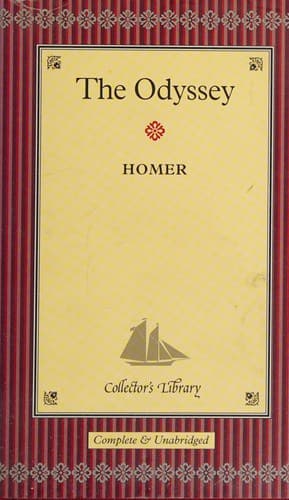
Epic poetry, Greek -- Translations into English; Homer -- Translations into English; Odysseus, King of Ithaca (Mythological character) -- Poetry
was here that Melesigenes became blind, but the Colophonians make their
city the seat of that misfortune. He then returned to Smyrna, where he
applied himself to the study of poetry.
But poverty soon drove him to Cumae. Having passed over the Hermaean
plain, he arrived at Neon Teichos, the New Wall, a colony of Cumae.
Here his misfortunes and poetical talent gained him the friendship of
one Tychias, an armourer. “And up to my time,” continues the author,
“the inhabitants showed the place where he used to sit when giving a
recitation of his verses; and they greatly honoured the spot. Here also
a poplar grew, which they said had sprung up ever since Melesigenes
arrived.”
But poverty still drove him on, and he went by way of Larissa, as being
the most convenient road. Here, the Cumans say, he composed an epitaph
on Gordius, king of Phrygia, which has however, and with greater
probability, been attributed to Cleobulus of Lindus.
Arrived at Cumae, he frequented the _conversaziones_ of the old men,
and delighted all by the charms of his poetry. Encouraged by this
favourable reception, he declared that, if they would allow him a
public maintenance, he would render their city most gloriously
renowned. They avowed their willingness to support him in the measure
he proposed, and procured him an audience in the council. Having made
the speech, with the purport of which our author has forgotten to
acquaint us, he retired, and left them to debate respecting the answer
to be given to his proposal.
The greater part of the assembly seemed favourable to the poet’s
demand, but one man “observed that if they were to feed _Homers_, they
would be encumbered with a multitude of useless people.” “From this
circumstance,” says the writer, “Melesigenes acquired the name of
Homer, for the Cumans call blind men _Homers_.” With a love of economy,
which shows how similar the world has always been in its treatment of
literary men, the pension was denied, and the poet vented his
disappointment in a wish that Cumae might never produce a poet capable
of giving it renown and glory.
At Phocaea Homer was destined to experience another literary distress.
One Thestorides, who aimed at the reputation of poetical genius, kept
Homer in his own house, and allowed him a pittance, on condition of the
verses of the poet passing in his name. Having collected sufficient
poetry to be profitable, Thestorides, like some would-be literary
publishers, neglected the man whose brains he had sucked, and left him.
At his departure, Homer is said to have observed: “O Thestorides, of
the many things hidden from the knowledge of man, nothing is more
unintelligible than the human heart.”
Public-domain text, read in full here on John Shaqi.
Reviews
Reviews
No reviews yet
Be the first to share your thoughts on this work.
Join the Discussion
Join the discussion
Sign in to leave a comment or review.
Sign InorCreate an account