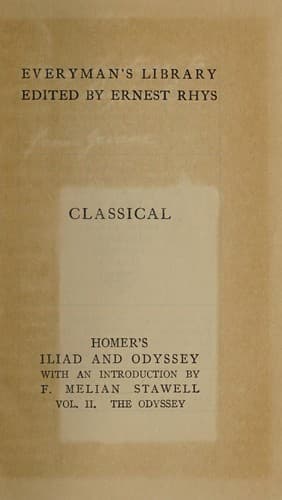
Epic poetry, Greek -- Translations into English; Homer -- Translations into English; Odysseus, King of Ithaca (Mythological character)
“Father Zeus, and ye other blessed gods, that live for ever, come
hither, that ye may see a mirthful thing and a cruel, for that
Aphrodite, daughter of Zeus, ever dishonours me by reason of my
lameness, and sets her heart on Ares the destroyer, because he is fair
and straight of limb, but as for me, feeble was I born. Howbeit, there
is none to blame but my father and mother,—would they had never
begotten me! But now shall ye see where these have gone up into my bed,
and sleep together in love; and I am troubled at the sight. Yet,
methinks, they will not care to lie thus even for a little while
longer, despite their great love. Soon will they have no desire to
sleep together, but the snare and the bond shall hold them, till her
sire give back to me the gifts of wooing, one and all, those that I
bestowed upon him for the hand of his shameless girl; for that his
daughter is fair, but without discretion.”
So spake he; and lo, the gods gathered together to the house of the
brazen floor. Poseidon came, the girdler of the earth, and Hermes came,
the bringer of luck, and prince Apollo came, the archer. But the lady
goddesses abode each within her house for shame. So the gods, the
givers of good things, stood in the porch: and laughter unquenchable
arose among the blessed gods, as they beheld the sleight of cunning
Hephaestus. And thus would one speak, looking to his neighbour:
“Ill deed, ill speed! The slow catcheth the swift! Lo, how Hephaestus,
slow as he is, hath overtaken Ares, albeit he is the swiftest of the
gods that hold Olympus, by his craft hath he taken him despite his
lameness; wherefore surely Ares oweth the fine of the adulterer.” Thus
they spake one to the other. But the lord Apollo, son of Zeus, spake to
Hermes:
“Hermes, son of Zeus, messenger and giver of good things, wouldst thou
be fain, aye, pressed by strong bonds though it might be, to lie on the
couch by golden Aphrodite?”
Then the messenger, the slayer of Argos, answered him: “I would that
this might be, Apollo, my prince of archery! So might thrice as many
bonds innumerable encompass me about, and all ye gods be looking on and
all the goddesses, yet would I lie by golden Aphrodite.”
So spake he, and laughter rose among the deathless gods. Howbeit,
Poseidon laughed not, but was instant with Hephaestus, the renowned
artificer, to loose the bonds of Ares: and he uttered his voice, and
spake to him winged words:
“Loose him, I pray thee, and I promise even as thou biddest me, that he
shall himself pay all fair forfeit in the presence of the deathless
gods.”
Then the famous god of the strong arms answered him: “Require not this
of me, Poseidon, girdler of the earth. Evil are evil folk’s pledges to
hold. How could I keep thee bound among the deathless gods, if Ares
were to depart, avoiding the debt and the bond?”
Then Poseidon answered him, shaker of the earth: “Hephaestus, even if
Ares avoid the debt and flee away, I myself will pay thee all.”
Public-domain text, read in full here on John Shaqi.
Reviews
Reviews
No reviews yet
Be the first to share your thoughts on this work.
Elsewhere in the archive
Join the Discussion
Join the discussion
Sign in to leave a comment or review.
Sign InorCreate an account