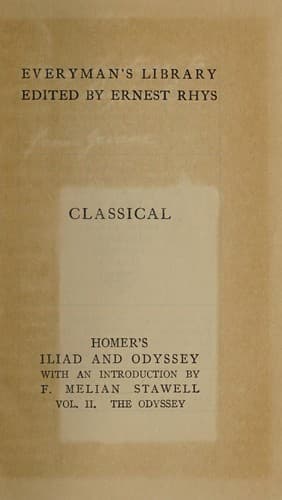
Epic poetry, Greek -- Translations into English; Homer -- Translations into English; Odysseus, King of Ithaca (Mythological character)
Now after the maids had bathed him and anointed him with olive oil, and
had cast a fair mantle and a doublet upon him, he stept forth from the
bath, and went to be with the chiefs at their wine. And Nausicaa,
dowered with beauty by the gods, stood by the pillar of the
well-builded roof, and marvelled at Odysseus, beholding him before her
eyes, and she uttered her voice and spake to him winged words:
“Farewell, stranger, and even in thine own country bethink thee of me
upon a time, for that to me first thou owest the ransom of life.”
And Odysseus of many counsels answered her saying: “Nausicaa, daughter
of great-hearted Alcinous, yea, may Zeus, the thunderer, the lord of
Here, grant me to reach my home and see the day of my returning; so
would I, even there, do thee worship as to a god, all my days for
evermore, for thou, lady, hast given me my life.”
He spake and sat him in the high seat by king Alcinous. And now they
were serving out the portions and mixing the wine. Then the henchmen
drew nigh leading the sweet minstrel, Demodocus, that was had in honour
of the people. So he set him in the midst of the feasters, and made him
lean against a tall column. Then to the henchman spake Odysseus of many
counsels, for he had cut off a portion of the chine of a white-toothed
boar, whereon yet more was left, with rich fat on either side:
“Lo, henchman, take this mess, and hand it to Demodocus, that he may
eat, and I will bid him hail, despite my sorrow. For minstrels from all
men on earth get their meed of honour and worship; inasmuch as the Muse
teacheth them the paths of song, and loveth the tribe of minstrels.”
Thus he spake, and the henchman bare the mess, and set it upon the
knees of the lord Demodocus, and he took it, and was glad at heart.
Then they stretched forth their hands upon the good cheer set before
them. Now after they had put from them the desire of meat and drink,
then Odysseus of many counsels spake to Demodocus, saying:
“Demodocus, I praise thee far above all mortal men, whether it be the
Muse, the daughter of Zeus, that taught thee, or even Apollo, for right
duly dost thou chant the faring of the Achaeans, even all that they
wrought and suffered, and all their travail, as if, methinks, thou
hadst been present, or heard the tale from another. Come now, change
thy strain, and sing of the fashioning of the horse of wood, which
Epeius made by the aid of Athene, even the guileful thing, that goodly
Odysseus led up into the citadel, when he had laden it with the men who
wasted Ilios. If thou wilt indeed rehearse me this aright, so will I be
thy witness among all men, how the god of his grace hath given thee the
gift of wondrous song.”
Public-domain text, read in full here on John Shaqi.
Reviews
Reviews
No reviews yet
Be the first to share your thoughts on this work.
Elsewhere in the archive
Join the Discussion
Join the discussion
Sign in to leave a comment or review.
Sign InorCreate an account