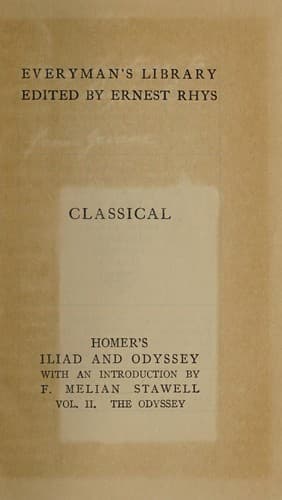
Epic poetry, Greek -- Translations into English; Homer -- Translations into English; Odysseus, King of Ithaca (Mythological character)
“Amphimedon, what hath befallen you, that ye have come beneath the
darkness of earth, all of you picked men and of like age? it is even as
though one should choose out and gather together the best warriors in a
city. Did Poseidon smite you in your ships and rouse up contrary winds
and the long waves? Or did unfriendly men, perchance, do you hurt upon
the land as ye were cutting off their oxen and fair flocks of sheep, or
while they fought to defend their city and the women thereof? Answer
and tell me, for I avow me a friend of thy house. Rememberest thou not
the day when I came to your house in Ithaca with godlike Menelaus, to
urge Odysseus to follow with me to Ilios on the decked ships? And it
was a full month ere we had sailed all across the wide sea, for scarce
could we win to our cause Odysseus, waster of cities.”
Then the ghost of Amphimedon answered him, and spake: “Most famous son
of Atreus, king of men, Agamemnon, I remember all these things, O
fosterling of Zeus, as thou declarest them, and I in turn will tell
thee all the tale well and truly, even our death and evil end, on what
wise it befell. We wooed the wife of Odysseus that was long afar, and
she neither refused the hated bridal nor was minded to make an end,
devising for us death and black fate. Also this other wile she
contrived in her heart. She set up in her halls a mighty web, fine of
woof and very wide, whereat she would weave, and anon she spake among
us:
“‘Ye princely youths, my wooers, now that goodly Odysseus is dead, do
ye abide patiently, how eager soever to speed on this marriage of mine,
till I finish the robe. I would not that the threads perish to no
avail, even this shroud for the hero Laertes, against the day when the
ruinous doom shall bring him low, of death that lays men at their
length. So shall none of the Achaean women in the land count it blame
in me, as well might be, were he to lie without a winding-sheet, a man
that had gotten great possessions.’
Public-domain text, read in full here on John Shaqi.
Reviews
Reviews
No reviews yet
Be the first to share your thoughts on this work.
Elsewhere in the archive
Join the Discussion
Join the discussion
Sign in to leave a comment or review.
Sign InorCreate an account