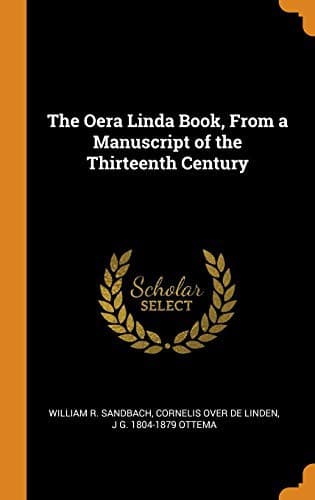
The Oera Linda Book, from a Manuscript of the Thirteenth Century
History
The Oera Linda Book, from a Manuscript of the Thirteenth Century
Frisian language -- Texts
In Germany the use of this material did not become very extended,
whether it came from Italy or Spain. Therefore the further this
preparation spread from the East and the adjoining countries,
the more necessity there was that linen should take the place of
cotton. A document of Kaufbeuren on linen paper of the year 1318
is of very doubtful genuineness. Bodman considers the oldest pure
linen paper to be of the year 1324, but up to 1350 much mixed paper
was used. All carefully-written manuscripts of great antiquity show
by the regularity of their lines that they must have been ruled,
even though no traces of the ruled lines can be distinguished. To
make the lines they used a thin piece of lead, a ruler, and a pair
of compasses to mark the distances.
In old writings the ink is very black or brown; but while there has
been more writing since the thirteenth century, the colour of the ink
is often grey or yellowish, and sometimes quite pale, showing that it
contains iron. All this affords convincing proof that the manuscript
before us belongs to the middle of the thirteenth century, written with
clear black letters between fine lines carefully traced with lead. The
colour of the ink shows decidedly that it does not contain iron. By
these evidences the date given, 1256, is satisfactorily proved, and
it is impossible to assign any later date. Therefore all suspicion
of modern deception vanishes.
The language is very old Fries, still older and purer than the Fries
Rjuchtboek or old Fries laws, differing from that both in form and
spelling, so that it appears to be an entirely distinct dialect,
and shows that the locality of the language must have been (as it
was spoken) between the Vlie and the Scheldt.
The style is extremely simple, concise, and unembarrassed, resembling
that of ordinary conversation, and free in the choice of the words. The
spelling is also simple and easy, so that the reading of it does
not involve the least difficulty, and yet with all its regularity,
so unrestricted, that each of the separate writers who have worked
at the book has his own peculiarities, arising from the changes in
pronunciation in a long course of years, which naturally must have
happened, as the last part of the work is written five centuries
after the first.
As a specimen of antiquity in language and writing, I believe I may
venture to say that this book is unique of its kind.
The writing suggests an observation which may be of great importance.
Public-domain text, read in full here on John Shaqi.
Reviews
Reviews
No reviews yet
Be the first to share your thoughts on this work.
Join the Discussion
Join the discussion
Sign in to leave a comment or review.
Sign InorCreate an account