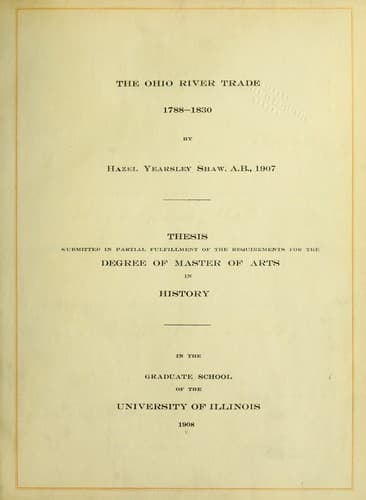
The Ohio River Trade, 1788-1830Shaw, Hazel Yearsley
History
The Ohio River Trade, 1788-1830
Shaw, Hazel Yearsley
Ohio River -- History; Ohio River Valley -- History
[110] Ibid., IV., 279.
[111] Louisiana Gasette, VI., 648; III., 286.
[112] Louisiana Gasette, III., 286.
[113] ibid., iii., 298.
[114] Ibid., VI., 525.
[115] Ibid. Louisiana Moniteur, May 10, 1809.
[116] Ibid., May 10, 1809.
[117] Louisiana Moniteur, May 10, 1809.
[118] Louisiana Gasette, p 2, Col. 3. May 21, 1808.
[119] Schultz, C., Travels, II., 200.
[120] Cuming, F., Tour, Early W. Travels, IV., 264.
[121] Schultz, C., Travels, II., 126.
[122] Niles, Weekly Register, I., 71.
[123] Cuming, F., Tour, Early W. Travels, IV., 97.
[124] Schultz, C., Travels, II., 56.
_CHAPTER III._
_EMIGRATION. GROWTH OF THE RIVER TOWNS._
One of the greatest hindrances to the early settlement of the
western territory was the continued hostility of the Indian tribes
living in that portion of the country. The two leading causes
of disquiet among the western people during the years 1787-1788
were due to this cause, and to the Spanish possession of the
Mississippi.[125] At Fort Harmar, January 9, 1789, one treaty was
made with the Iroquois, confirming the previous one of October 22,
1784, at Fort Stanwix,[126] and another with the Wyandots, Delawares,
Ottawas, Pottawatomies, and Sacs, confirming and extending the
treaty of Fort McIntosh, made in January 21, 1785.[127]
These treaties were not respected, and the year 1790 saw the old
frontier troubles renewed. The Wabash Indians, especially, who had
not been bound by any treaty as yet, kept up incursions against
the Kentucky settlers, and the emigrants down the Ohio.[128] Three
boats descending the Ohio River in March, 1790 were attacked
by twenty-two Indians, above the Falls, and twenty-six horses,
merchandise valued at from twelve to fifteen pounds, and several
saddlebags containing cash were lost by being left in the two
abandoned boats.[129] "The pioneers who descended the Ohio on their
way westward, will remember while they live, the lofty rock
standing a short distance above the mouth of the Scioto, on the
Virginia shore, which was occupied for years by the savages,
as a favorite watch-tower, from which boats ascending and
descending, could be discovered at a great distance. The murders
and depredations committed in that vicinity at all periods of the
war were so shocking as to attract universal notice, and letters
were written to General Harmar, from various quarters, calling his
attention to the subject. They informed him that scarcely a boat
passed the rocks without being attacked, and in most instances
captured; and that unless something were done without delay,
the navigation of the river would necessarily be abandoned."[130]
September 19, 1790 Governor St. Clair notified the War Department
that the depredations continued on the Ohio and Wabash; that nearly
every day brought an account of some new robbery or murder; and
that shortly before this, a boat belonging to Colonel Vigo of
Post Vincennes, was fired upon near the mouth of Blue River, and
Public-domain text, read in full here on John Shaqi.
Reviews
Reviews
No reviews yet
Be the first to share your thoughts on this work.
Join the Discussion
Join the discussion
Sign in to leave a comment or review.
Sign InorCreate an account