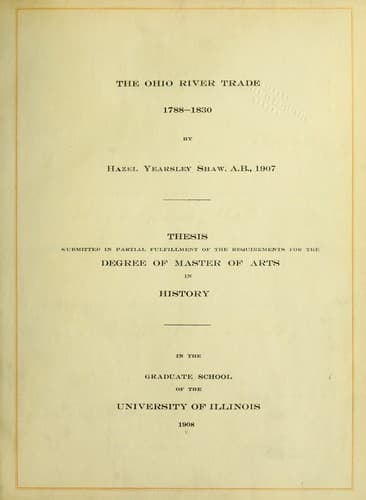
The Ohio River Trade, 1788-1830Shaw, Hazel Yearsley
History
The Ohio River Trade, 1788-1830
Shaw, Hazel Yearsley
Ohio River -- History; Ohio River Valley -- History
three men killed, and later, in attempting to ascend the Wabash,
the boats were attacked and the crew's personal baggage and arms
stolen. As the boat was navigated by Frenchmen, the Indians
suffered them to depart with the peltries.[131] Pope, in 1791, speaks
of being frequently alarmed at the hostile appearance of Indians
onboth sides of the Ohio, who suspecting that the number of white
men was greater than their own, were deterred from attacking
them.[132]
The savages who assailed the new settlements in the West, resided
chiefly on the northwest side of the Ohio River. The British
government, alarmed at the advance of the United States westward,
had established agencies among them for the sole purpose of keeping
alive their hatred against the American people.[133] The frequent,
predatory movements of the savages, following in such rapid
succession, produced universal alarm throughout the country, and
the sttlers began to think that they would be obliged to abandon
it.[134] The glorious campaign of General Wayne with his defeat
of the western savages at the Battle of the Miami, 1794, put an
end to this warfare.[135] The Treaty of Greenville,[136] signed
by the various Indian nations, on August 3, 1795, and ratified by
the Senate on December 22, closed the old Indian Wars of the West.
In 1796, after some delay, the British government surrendered the
northern posts,[137] thus removing the danger from that quarter.
On July 13, 1787 the Ordinance of 1787 was passed;[138] which because
of its wise provisions and liberal terms, may be considered as one
of the most important documentsin our history. The whole territory
lying north and west of the Ohio, extending to the Mississippi,
and to the northern lakes, was comprehended within one district,
for temporary government. The act contained a provision for the
creation of not less than three, nor more than five States, each
State to have at least 60,000 free population.[139] The prohibition
of slavery probably aided in attracting settlers to this region
The fourth article provided that "thenavigable waters leading into
the Mississippi and St. Lawrence, and the carrying places between
the same, shall be common highways and forever free, as well to
the inhabitants of the said territories, as to the citizens of the
United States, and those of other States that may be admitted to
the Confederacy without any tax, import, or duty therefor."[140]
Public-domain text, read in full here on John Shaqi.
Reviews
Reviews
No reviews yet
Be the first to share your thoughts on this work.
Join the Discussion
Join the discussion
Sign in to leave a comment or review.
Sign InorCreate an account