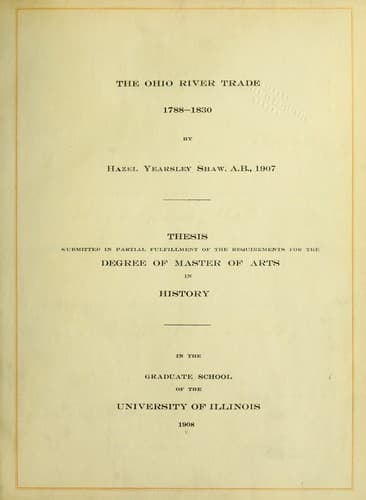
The Ohio River Trade, 1788-1830Shaw, Hazel Yearsley
History
The Ohio River Trade, 1788-1830
Shaw, Hazel Yearsley
Ohio River -- History; Ohio River Valley -- History
In the year 1787, the Ohio Company purchased 1,500,000 acres of
land from Congress. The total price agreed upon was nearly three
and a half million dollars, but the payment was made in public
securities worth only about twelve cents on the dollar.[141] Joel
Barlow was sent to Europe to sell the lands, and a subordinate
association, called the Scioto Company, was formed to aid him. Mr.
Barlow made considerable sales to individuals and companies in
France, and many emigrants came to this country, who would have
been ruined by the bad faith of the Company, had not the government
generously interfered in their behalf.[142] From 1790-1795 the Ohio
Company expended more than $11,000 in defending their settlements,
which was never repaid them by the United States.[143] J. C. Symmes
of New Jersey in 1787, entered into a contract with Congress for
the purchase of a million acres between the two Miami Rivers. He
finally paid for about one third of it, for which he received a
patent.[144]
The early adventurers to the Northwest Territory were men who had
spent the prime of their lives in the War of Independence. Many
of them had exhausted their fortunes in maintaining the desperate
struggle, and retired to the wilderness to conceal their poverty.
Some of them were young men, descended from revolutionary patriots.
Others were adverturous spirits to whom any change might be for the
better.[145]
The emigration westward, even in 1788, was very great, the
commandant at Fort Harmar reporting forty-five hundred persons
having passed that post between February and June of that year.[146]
Emigrants were constantly passing down the Ohio for Kentucky in
1789.[147] Prior to the year 1795, the east side of the river,
for about ten or twenty miles below Wheeling was generally well
settled. There were few settlements on the opposite shore until the
Muskingum River was reached, and from here to Limestone, "except at
the mouth of the Great Kanhaway," the country on both sides of the
river was a wilderness.[148] "Till the years 1796-1797 the banks of
the Ohio were so little populated that they scarcely consisted of
thirty families in a space of four hundred miles."[149]
Public-domain text, read in full here on John Shaqi.
Reviews
Reviews
No reviews yet
Be the first to share your thoughts on this work.
Join the Discussion
Join the discussion
Sign in to leave a comment or review.
Sign InorCreate an account