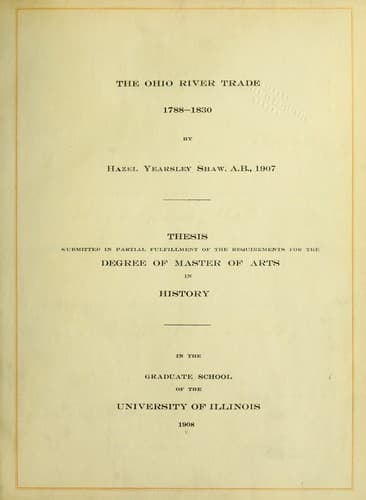
The Ohio River Trade, 1788-1830Shaw, Hazel Yearsley
History
The Ohio River Trade, 1788-1830
Shaw, Hazel Yearsley
Ohio River -- History; Ohio River Valley -- History
Pittsburg, the great gateway of the West, stood at the point where
the Allegheny and Monongahela Rivers joined to form the Ohio River,
and was the usual point of embarkation for emigrants bound down the
river. As early as the year 1784 Pittsburg was inhabited almost
entirely by the Scotch and Irish who lived in paltry log houses.
A good deal of trade was carried on, the goods being brought from
Baltimore and Philadelphia at the expense of 45 shillings per
hundred, and exchanged by the merchants in the shops, for money,
wheat, flour and skins.[172] Merchandise was sent from Pittsburg in
Keels and flatboats down the Ohio to Limestone and Louisville. In
the spring of the year 1784 the town was laid out and surveyed
by Col. George Woods, by order of Teucle Francis, attorney for
John Penn, and J. Penn, Junior.[173] John Pope in 1790 gives most
anything but a pleasing account of the town. He says, "The town at
present, is inhabited with only some few exceptions, by mortals who
act as if possessed of a charter of exclusive privilege to filch
from, annoy, and harass her fellow creatures, particularly the
incautious and necessitous; many who have emigrated from various
parts of Kentucky can verify the charge. Goods of every description
are dearer in Pittsburg than in Kentucky, which I attribute to
a combination of pensioned scoundrels who infest the place."[174]
The increase of the town was not rapid until the year 1793, in
consequence of the inroads of the savage tribes which impeded the
growth of the neighboring settlements. The Western insurrection
more generally known as the "Whiskey War," once more made this
the scene of commotion, and is said to have given pittsburg a new
and revising impulse, by throwing a considerable sum of money
into circulation.[175] From that time it increased rapidly, and on
April 22, 1794 was incorporated as a borough.[176] In 1795 Pittsburg
contained about two hundred houses, fifty brick and frame, and the
remainder log[177].
The surplus produce of the country about Pittsburg, was, during
this time, consumed by the numerous emigrants who were continually
passing down the Ohio.[178] Goods from Philadelphia and Baltimore
were sent to Pittsburg, stored there in warehouses,[179] and later
sent down the Ohio to Kentucky, Tennessee, and the Northwest
Territory.[180] The gain on these goods sent to Kentucky was about 33
per cent.[181] Little effort had been made to establish manufactures,
even for articles of the first necessity, these being obtained
from Philadelphia and Baltimore at exorbitant prices.[182] The
carriage from Philadelphia to Pittsburg was from $8 to $10, and
from Baltimore $7 ot $8, two wagons, nevertheless, coming from
Philadelphia against one from Baltimore.[183]
Public-domain text, read in full here on John Shaqi.
Reviews
Reviews
No reviews yet
Be the first to share your thoughts on this work.
Join the Discussion
Join the discussion
Sign in to leave a comment or review.
Sign InorCreate an account