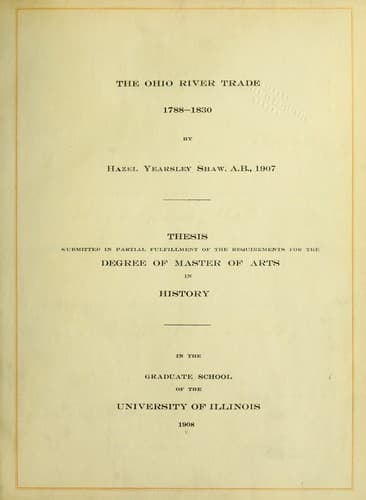
The Ohio River Trade, 1788-1830Shaw, Hazel Yearsley
History
The Ohio River Trade, 1788-1830
Shaw, Hazel Yearsley
Ohio River -- History; Ohio River Valley -- History
Boat building was carried on in Pittsburg at this time, but Collot
advised travelers to buy their boats on the Monongahela, where the
greater number were built as they would in that way be able to save
much time and about one-third of the expense.[184] By the year 1802
the ship building industry had assumed importance in Pittsburg, one
of the principal ship yards being upon the Monongahela The lumber
being near at hand rendered the expense of building less than that
in the Atlantic States. The cordage was manufactured at Redstone
and Lexington, and sent also to Marietta and Louisville where ships
were built.[185] In 1802 a three mast vessel of 150 tons and bin
of 90 were launched at Pittsburg, and during the spring of 1803,
three ships from 160 to 275 tons were launched.[186] The merchants
living in or near Pittsburg were either the partners, or else the
factors, belonging to the houses of Philadelphia.[187] Trading boats
were sent out from Pittsburg to supply the settlements along the
River.[188]
Schultz, 1807, writes thus of Pittsburg, "There are probably
between 60 and 70 stores, well stocked with every kind of goods.
The price of wagon carriage from this distance, (Philadelphia and
Baltimore), is $5 and $6 a hundred pounds weight. It contains
between 400 and 500 houses. From the best information I could
collect, it is supposed to contain at least 2500 inhabitants, the
most of whom are German and Irish settlers from various parts
of Pennsylvania and Maryland. This town has likewise a number
of public buildings, principally built of brick. Ship building
is carried on here with considerable spirit; they have already
launched about one dozen brigs and schooners. Boat building, boat
buying, and boat selling seem to be part of the business of at
least half of the town. Pittsburg has likewise a considerable
number of factories established already, among which may be
enumerated distilleries, breweries, printing presses, an air
furnace, a glass house and cotton factory; likewise, smaller
establishments for the manufacture of nails, brushes, ropes,
copperware, tinware, and earthenware, with many others too tedious
to mention, Pittsburg appears to be in the "full tide of successful
experiment."[189]
Public-domain text, read in full here on John Shaqi.
Reviews
Reviews
No reviews yet
Be the first to share your thoughts on this work.
Join the Discussion
Join the discussion
Sign in to leave a comment or review.
Sign InorCreate an account