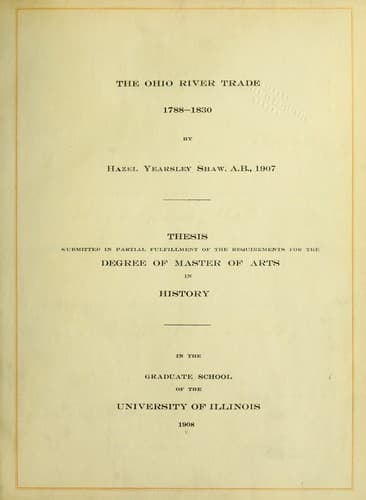
The Ohio River Trade, 1788-1830Shaw, Hazel Yearsley
History
The Ohio River Trade, 1788-1830
Shaw, Hazel Yearsley
Ohio River -- History; Ohio River Valley -- History
Limestone, Kentucky, in 1790 was a little town and the point where
emigrants from Virginia disembarked.[214] It later, 1796, became the
depot for whatever goods passedfrom Baltimore and Philadelphia to
Kentucky.[215] The grow th of the town was slow, and in 1807 they
were only 80 houses. Schultz says, "from the great number of boats
of every description lying along the shore, it must have a very
considerable share of business. Ship building, I was informed, is
likewise carried on with much spirit, but I saw nothing of the kind
going on while I was there."[216]
Louisville was, in 1796, a small settlement containing from 80 to
100 houses.[217] This was one of the earliest settlements on the Ohio
and was rendered the more important at that time, by its position
at the Falls of the Ohio. All the boats which touched at Louisville
to take pilots were obliged to ascend the river more than two miles
above the town to gain the current on the opposite side, which led
to considerable expense and loss of time. This disadvantage in the
situation of the town probably prevented it from increasing.[218]
The Falls were occasioned by a bed of rocks extending from one
side of the river to the other. There was a fall of 22½ feet in
two miles.[219] In the year 1807 the legislature of Kentucky had
incorporated a Company for the purpose of opening a canal around
the Falls.[220] At this time Louisville contained 120 houses. Ship
and boat building was carried on with considerable spirit.[221]
Pilots were appointed to conduct boats over the falls, at the price
of $2 per boat.[222]
Steubenville, Ohio, laid out in 1798, and incorporated as a
town in 1805,[223] contained, in 1807, about 130 houses, a number
of brick buildings, and several stores well stocked with every
kind of merchandise.[224] Chillicothe, was laid out on the Scioto
by Nathaniel Massie in 1796. Galliopolis, settled in 1791, by a
French colony,[225] is a good example of the bad faith of the Scioto
Company.[226] This town rapidly declined.[227]
Fort Vincents and Jeffersonville, Indiana, were in 1796, small
villages, one of 50 houses,[228] and the other 40 houses.[229]
In 1796 a large number of merchants had already established
themselves at Frankfort on the Kentucky River, which was navigable
for the largest boats ten months in the year.[230] Henderson,
Kentucky, carried on a considerable export trade 1807-1809.[231]
Shawneetown, Illinois, made its first appearance in 1805 and 1806,
and increased considerably for some time. Great fleets of Keel
boats concentrated at this point, engaged in the salt, and other
traffic, and diffused life and energy to the new colonies.[232]
Cuming says, 1807-1809, "there were several trading boats, and
more appearance of business than I had seen on this side of
Pittsburg."[233]
Brownsville, on the Monongahela, and McKeesport on the Youghiogheny
carried on an extensive boat-building business, in 1803, furnishing
craft for the emigrants.[234]
Public-domain text, read in full here on John Shaqi.
Reviews
Reviews
No reviews yet
Be the first to share your thoughts on this work.
Join the Discussion
Join the discussion
Sign in to leave a comment or review.
Sign InorCreate an account