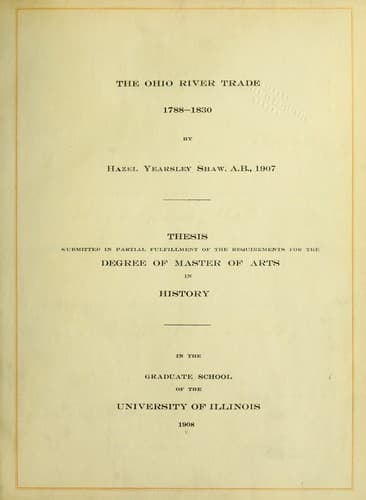
The Ohio River Trade, 1788-1830Shaw, Hazel Yearsley
History
The Ohio River Trade, 1788-1830
Shaw, Hazel Yearsley
Ohio River -- History; Ohio River Valley -- History
The settlement of the Ohio Company's purchase commenced in April
1788, when they planted the colony of Marietta at the junction of
the Ohio and Muskingum Rivers.[202] By the end of the year about 300
persons had settled in Marietta, and aside from these there was not
a single white family within the present bounds of Ohio.[203] In
1795 the town contained about 200 wooden houses, and was protected
from theattacks of the Indians by soldiers stationed there. From
1790-1795 the Indians were very troublesome and stole a great
number of horses from the settlers.[204] The population, at this
time, was composed of five or six hundred families from New England
and a few unfortunate French families, the victims of American
land speculators, and of the ignorance of the chiefs of the Scioto
Company.[205]
As early as the year 1798 or 1799 Commodore Preble built a brig
of 120 tons at this place, which probably was the first sea
vessel launched in the western waters.[206] "The inhabitants of
Marietta were the first that had an idea of exporting directly
to the Carribee Islands the produce of the country, in a vessel
built in their own town, which they sent to Jamaica. The success
which crowned this first attempt excited such emulation among the
inhabitants of that part of the western country, that several new
vessels were launched at Pittsburg and Louisville, and expedited
to the Isles, or to New York and Philadelphia."[207] The ship yard
at Marietta was on the Muskingum, and there in 1803 was built
the brig "Mary Avery" of 130 tons.[208] The ship building industry
increased; ships completely equipped for sea at $50 a ton, brigs,
schooners,[209] and bun boats[210] were built at Marietta in 1807.
Schultz says, "Ship building is carried on here with more spirit
than any other town on the Ohio."[211] From 1801-1808 ship building
was carried on with great spirit at Marietta, not less than 20
ships, brigs, and schooners, from 150 to 450 tons being built,
besides some gun boats.[212] The embargo of 1808 overwhelmed several
of these merchants with ruin, especially such as had ships on hand
unsold. One man who had a ship in New Orleans at the time lost
$10,000 on her and the cargo. No town in the United States suffered
so much as this, according to its capital. Three extensive rope
walks, working up large quantities of hemp raised in the country,
and furnishing rigging for the ships, were put out of employ, and
in a few years fell into ruins. The business of the town did not
revive for many years.[213]
Public-domain text, read in full here on John Shaqi.
Reviews
Reviews
No reviews yet
Be the first to share your thoughts on this work.
Join the Discussion
Join the discussion
Sign in to leave a comment or review.
Sign InorCreate an account