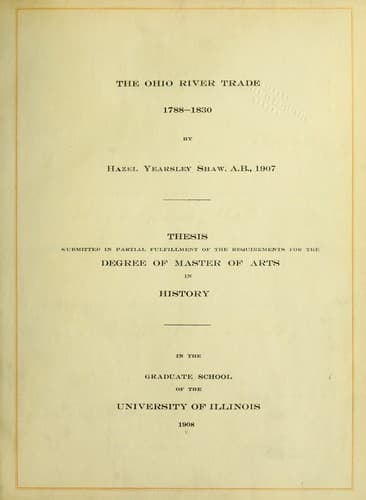
The Ohio River Trade, 1788-1830Shaw, Hazel Yearsley
History
The Ohio River Trade, 1788-1830
Shaw, Hazel Yearsley
Ohio River -- History; Ohio River Valley -- History
That the importance of the steamboat to the commerce of New Orleans
was clearly recognized as early as 1815, is shown by the following
newspaper article. "We have had undoubted proofs of the good
effects of the steamboat navigation between this city (New Orleans)
and Natchez, and why not extend its beneficial effects to the Ohio
and to the different navigable streams emplying into that river.
The want of public spirit, properly directed has retarded the
salutary object so long. If enterprising men would propose and
form associations and companies for building steamboats on the
different navigable waters west of the Allegheny mountains it is
reasonable to suppose that few men of capital would withhold their
support ... surely interest most clearly points out something like
the foregoing plan to immediately operate in favor of the trade of
the rivers Ohio and Mississippi. The steamboats now in use cannot
carry one twentieth part of the goods that might be in demand from
this city.... Experience alone will establish what size of boats,
or draught of water will be best for the navigation of both rivers
... it appears very reasonable, however, to suppose that the boats
of small draught of water would be best calculated for the Ohio,
taking into consideration the different stages of the water and
how subject that river is to fall very low.... To the commercial
interest of New Orleans the steam navigation is of immense
consideration, the vast sums of money annually paid in Philadelphia
and Baltimore for goods, and carried over the mountains in wagons,
would concentrate here. View the course of trade. The merchants
of Cincinnati, Lexington, Nashville, and the small towns in the
western states, after the extreme labor, anxiety and expense of
getting their goods carried from the seaboard by land, are obliged
to receive produce in payment, which is floated down to this
city, and converted into money for the coffers of the New York,
Philadelphia, and Baltimore importers--whereas, if the steamboats
were in complete operation, the whole western states could be
supplied with every kind of goods here, and on better terms than
they now are from Philadelphia and Baltimore ... but certainly
it is not chimerical to say that if exertions are not made by
individuals, or companies through views of gain or otherwise to
bring more steamboat tonnage into use for the western trade, it
would have been better (as it relates to that trade) that the steam
boats had never been in operation--then the old laborious, tedious
barging would have continued in full vigor."[261]
Public-domain text, read in full here on John Shaqi.
Reviews
Reviews
No reviews yet
Be the first to share your thoughts on this work.
Join the Discussion
Join the discussion
Sign in to leave a comment or review.
Sign InorCreate an account