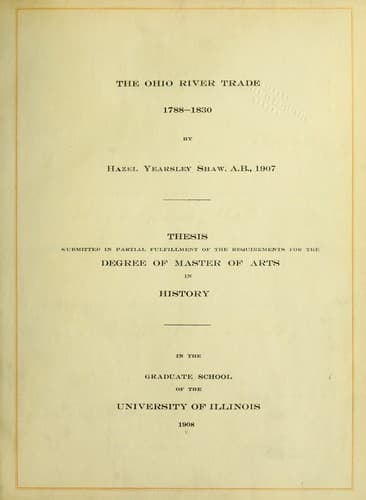
The Ohio River Trade, 1788-1830Shaw, Hazel Yearsley
History
The Ohio River Trade, 1788-1830
Shaw, Hazel Yearsley
Ohio River -- History; Ohio River Valley -- History
The steamboats, making occasional trips up and down the river,
created great excitement along the banks, and at the towns and
villages their arrival and landings were great occasions.[262] These
boats were a queer style of water craft, as they had not assumed
the forms that were afterward found to be suited to the river
navigation. Their builders copied the models of ships adapted to
deep water, and the boats all drew too much water to be available
in the dry season, so that they could not be used on the upper Ohio
more than about three months in the year. They looked just like a
small ship without masts. Some of them were of peculiar models, and
all of them had very little power in comparison with boats built
later. The first boats had no more decking than a common sailing
vessel. Very few of them could make over 2 or 3 miles against the
stream when it was strong.[263]
When Fulton commenced steamboat building, be patented the side
paddle wheels, and held a monopoly of that form of boat. Niles
notes the following incidents arising from this monopoly.
"Mr. Livingston of New Orleans under a patent of the State of
Louisiana, as the assignee of Fulton and Livingston's exclusive
right to navigate the Mississippi and its waters, by steam, so
far as respects the navigation from New Orleans to and up the Red
River, has prevented the steamboat Despatch, of Pittsburg, from
taking a return cargo at New Orleans, though it appears she is
worked by machinery quite distinct from that under the aforesaid
patent. He has, however, permitted her to go out of the limits
of the State without incurring a penalty. The procedure appears
likely to create much sensation in the "western world."[264] "The
Louisville Correspondent" announces a second attempt of the
Livingston steamboat company to interrupt the steam navigation of
the Mississippi by boats not under their charter. The procedure
excites much sensibility in the western world."[265] "The question
of Fulton and Livingston's privilege is again agitated by a suit
brought in the federal court of New Orleans, against the steamboat
Constitution. We wait with anxiety the result of a question
involving the most prominent interests of W. America."[266] The
evasion in many of the western boats consisted of placing a wheel
on each side of the keel at the stern of the vessel, so that the
wheels were out of sight from behind.[267]
The General Pike, built at Cincinnati in 1818, and intended to ply
as a packet between Maysville, Cincinnati, and Louisville, is said
to have been the first steam boat constructed on the western waters
for the exclusive convenience of pass engers. The length of her
cabin was 40 feet, the breadth 25 feet, in addition to which there
were fourteen state rooms.[268]
Public-domain text, read in full here on John Shaqi.
Reviews
Reviews
No reviews yet
Be the first to share your thoughts on this work.
Join the Discussion
Join the discussion
Sign in to leave a comment or review.
Sign InorCreate an account