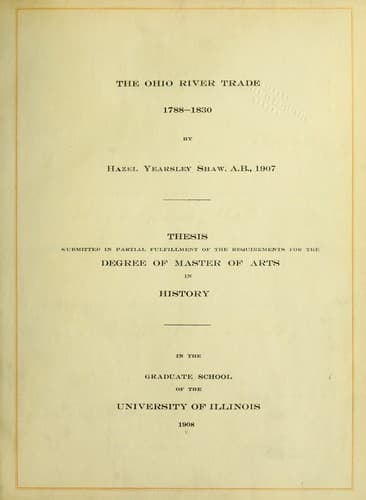
The Ohio River Trade, 1788-1830Shaw, Hazel Yearsley
History
The Ohio River Trade, 1788-1830
Shaw, Hazel Yearsley
Ohio River -- History; Ohio River Valley -- History
In 1818, rates for passengers from New Orleans to the mouth
of the Ohio was $95; from New Orleans to Shawneetown $105; to
Shippingsport $125; children from 2 to 10 years at half price;
children under two at one fourth price; and servants at half
price.[292] The passage up the river to the Falls, in 1819, cost
$100, including provisions; from Shippingsport to New Orleans the
cost was $75.[293] The passage up the river to Cincinnati from New
Orleans in 1823 was $50; Cincinnati to New Orleans, $25; Cincinnati
to Louisville, $4; Louisville to Cincinnati, $6; Cincinnati to
Pittsburg, $15; Pittsburg to Cincinnati, $12; Cincinnati to
Wheeling, $14; and from Wheeling to Cincinnati $10.[294] In 1827
the passage up the river to Louisville was about eight pounds,
which included every expense of living. Many of the vessels carried
seven hundred passengers, besides merchandise.[295] A year later, the
regular charge for a cabin passenger was $35 from New Orleans to
Louisville; for a deck passenger the rate was $10, $2 being struck
off, if they were willing to assist in carrying wood.[296] By 1830
passage from Louisville to New Orleans and back was reduced to $30
each way.[297]
Steamboats with their safety barges in tow were to be seen on the
Ohio. The Merchant from Pittsburg to Cincinnati, having in two her
safety barge with 95 passengers, in 1826, was the first attempt of
the kind. The barge had 52 berths and 3 cabins. The steamboat had 2
cabins.[298]
Goods were carried, about the year 1818, at 6¼ cents per pound
weight,[299] by 1820 the increase of craft, together with the
decreasing quantity of goods imported, had lowered the freight
from New Orleans to the Falls of the Ohio to 2 cents per pound.[300]
In 1829-1830 goods were delivered at the wharf of Cincinnati for
one dollar per hundred pounds, from Philadelphia by way of New
Orleans.[301]
The larger boats, on account of the shallowness of the water,
usually ascended no farther than Shippingsport.[302] The navigation
of the Ohio was often obstructed part of the year by large masses
of floating ice.[303] From the middle of February or the first of
March to the end of June, and in October or November were the best
seasons for navigating the Ohio.[304]/
Public-domain text, read in full here on John Shaqi.
Reviews
Reviews
No reviews yet
Be the first to share your thoughts on this work.
Join the Discussion
Join the discussion
Sign in to leave a comment or review.
Sign InorCreate an account