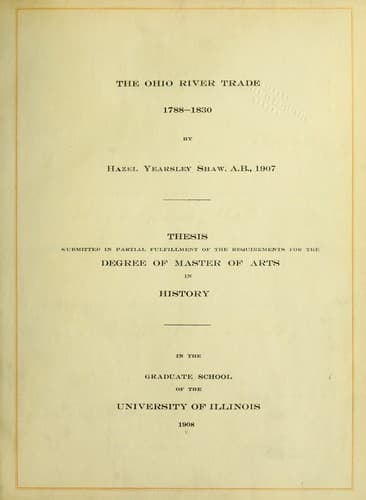
The Ohio River Trade, 1788-1830Shaw, Hazel Yearsley
History
The Ohio River Trade, 1788-1830
Shaw, Hazel Yearsley
Ohio River -- History; Ohio River Valley -- History
The steamboats were in constant danger from Planters, Sawyers,
and Wooden Islands in the river. A Planter was a tree rooted fast
to the bottom of the river and rotted off level with the water.
Sawyers were less firmly rooted, and rose and fell with the water,
being more dangerous when they pointed down stream. Wooden Islands
were logs accumulated against planters.[305] From 1822-1827, the
loss of property on the Ohio and Mississippi by snags alone,
including steam and flat boats, and their cargoes, amounted to
$1,362,500. The losses on the same items, from 1827-1832, were
reduced to $381,000 in consequence of the beneficial action of the
snag boats.[306] These boats, constructed under the direction of the
government, were successful in removing these obstacles at small
expense, and with great facility.[307]
As the settlements and business of the valley of the Ohio
increased, the danger, delay, and expense of passing the Falls
of that river, became a subject of general solicitude. Men of
intelligence and enterprise, who were engaged in the river trade
at Pittsburg, Cincinnati, and the intermediate towns, having
been subjected to the inconvenience and expense caused by that
obstruction, from the first settlement of the country, began to
discuss the question, whether the difficulty could not be removed.
William Noble, an enterprising merchant of Cincinnati, found that,
at the time when the commerce of the West was in its infancy,
the loss sustained by traders residing above the Falls, amounted
in one year to $80,000, including storage, drayage, cooperage,
commissions, and the wages of hands during the delay.[308]
Public-domain text, read in full here on John Shaqi.
Reviews
Reviews
No reviews yet
Be the first to share your thoughts on this work.
Join the Discussion
Join the discussion
Sign in to leave a comment or review.
Sign InorCreate an account