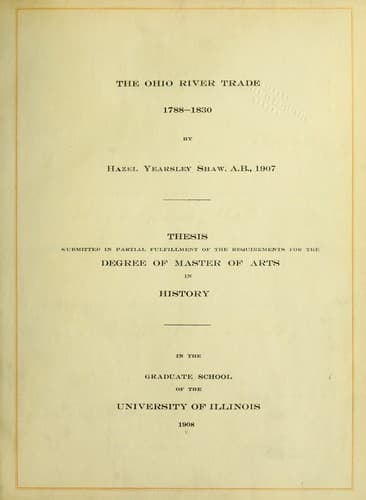
The Ohio River Trade, 1788-1830Shaw, Hazel Yearsley
History
The Ohio River Trade, 1788-1830
Shaw, Hazel Yearsley
Ohio River -- History; Ohio River Valley -- History
The Falls were impassable for steamboats, except during the high
floods which usually occurred in the spring and continued for a
few days only at a time. They were passed by means of a laborious
and expensive portage, extending from Louisville to Shippingsport,
a distance of two and a half miles.[309] To remedy these
inconveniences, the Louisville and Portland Canal was built round
the Falls.[310] The first steamboat that passed through the Canal was
the Uncas, on December 21, 1829.[311] This work,which was intended as
a great benefit to the commerce of the West, seemed to have failed
in accomplishing that purpose, for the following reasons: I. During
the greater part of the year it afforded the only outlet for the
productions of the larger portion of the Ohio Valley, and the only
channel of ingress for the valuable imports of the same region. It
was found that boats of great length were those of the greatest
speed, and best suited to the navigation of the rivers, and the
character of the trade. The length which was found most convenient
was greater than the dimension of the locks of the Canal, and thus
the boats best adapted to the trade between Pittsburg, Cincinnati,
and other ports on the upper Ohio, and St. Louis or New Orleans,
were excluded from that commerce, and a smaller class of boats,
which were much less profitable, were exclusively employed.[312]
II. The width of the Canal was such that steamboats could not pass
each other within it, nor could a loaded boat work her way through,
but by a great effort, which occasioned a great loss of time.
III. Excessive tolls were levied, thus imposing an unjust burden
upon the owners of the boats navigating the Ohio. The government,
as a stockholder, participated in these profits.[313]
In spite of these various adverse conditions, steamboats on the
Ohio and Mississippi rapidly increased, and gradually took the
place of the slower and more clumsy draft which had formerly
enjoyed a monopoly of the carrying trade on those rivers.
FOOTNOTES:
[235] Hall, J., The West, 10-11.
[236] Hall, J., Sketches, II., 72.
[237] Latrobe, C. J., The Rambler, I., 104-105.
[238] Ibid. Peck, J. M., Annals, 592. Thomas, D., Travels, 272.
[239] Latrobe, C. J., The Rambler, I., 105.
[240] Ibid. Louisiana Gasette, October 9, 1811. "A steamboat was
advertised to sail from Pittsburg for this place on the 20th
Ult. She is intended, we are informed, to be a regular packet
between New Orleans and Natchez."
[241] Latrobe, C. J., The Rambler, I., 105-106. Peck, J. M.,
Annals, 593.
[242] Latrobe, C. J., The Rambler, I., 109. Peck, J. M., Annals,
593. Flint, T., History and Geography, I., 173. Says that the
boat descended from Pittsburg to New Orleans in 259 hours.
[243] Louisiana Gasette, January 11, 1812. p. 3. col. 3.
[244] Hall, J., The West, 123.
[245] Ibid., 123.
[246] Niles, Weekly Register, VI., 197.
[247] Niles, Weekly Register, VI., 198.
[248] Ibid., VI., 320.
Public-domain text, read in full here on John Shaqi.
Reviews
Reviews
No reviews yet
Be the first to share your thoughts on this work.
Join the Discussion
Join the discussion
Sign in to leave a comment or review.
Sign InorCreate an account