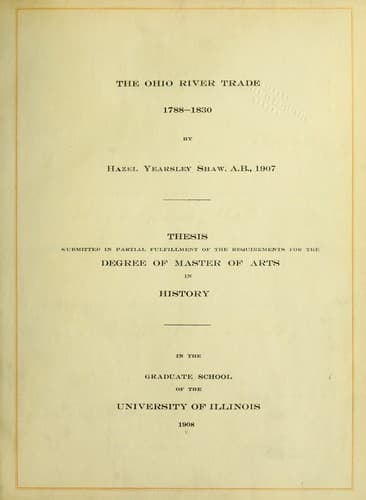
The Ohio River Trade, 1788-1830Shaw, Hazel Yearsley
History
The Ohio River Trade, 1788-1830
Shaw, Hazel Yearsley
Ohio River -- History; Ohio River Valley -- History
In addition to the keel, barge, and flat boat, which were in
general use, many other strange craft floated on the Ohio, a few
of which I shall attempt to give some account of. The boat which
carried the advance guard of the Ohio Company and their provisions
to the mouth of the Muskingum in 1788, was built by Jonathan Devol
at Simrel's Ferry on the Youghiogheny River, and is said to have
been the first decked boat that ever floated on the Ohio.[23] She
was built with stout timbers and knees like a galley, with the
bottom raking fore and aft, and decked over with planks. The deck
was sufficiently high for a man to walk upright under the beams,
and the sides so thick as to resist a rifle bullet. The steersman
and rowers were thus safely sheltered from the attack of enemies on
the banks. The boat was forty-five feet in length, and twelve in
breadth. Subsequently gangboards were added on the outside, so that
she could be pushed against the current, like a keel boat. It was
at first supposed that she could be worked up stream with sail, but
the variable nature and uncertainty of the winds on the Ohio River,
frustrated their arrangements.[24]
Emigrants were usually, at this early period, 1789, detained for
several days for a boat to be made ready for their use. Such a
boat, conveying settlers to Marietta, was built after the fashion
of a large, oblong box, covered half its length with a roof to
shelter the people and their goods from the weather, while the
open space contained their teams and wagons. The waters of the
Youghiogheny and the Monongahela were low, and the boat grounded on
sand bars, requiring the voyagers to lean over the side into the
cold water, and pry her off into the current.[25] In 1790, John Pope
describes the boat in which he left Pittsburg, as "a moveable
fortification having about one hundred and fifty salt pans so
arranged, as to render a few men within, capable of repulsing ten
times their number without."[26]
In the year 1803, family boats were continually passing down the
Ohio.[27] "These boats were of the largest size, and the floors were
covered with rough sawed boards. In the rear a partition had been
run across, in which they had stowed all their present useless
furniture. Through the middle was a passage about five feet wide,
on each side were small bed chambers of about twelve feet long and
six wide, divided and surrounded by clean white curtains, while
in front there was a large open space for the general use of the
boat."[28] Emigrant families frequently passed down the Ohio in
barges, "carrying with them their horses, cows, poultry, wagons,
ploughs, harness, beds, instruments of agriculture, in fine,
everything necessary to cultivate the land, and also for domestic
use."[29]
Public-domain text, read in full here on John Shaqi.
Reviews
Reviews
No reviews yet
Be the first to share your thoughts on this work.
Join the Discussion
Join the discussion
Sign in to leave a comment or review.
Sign InorCreate an account