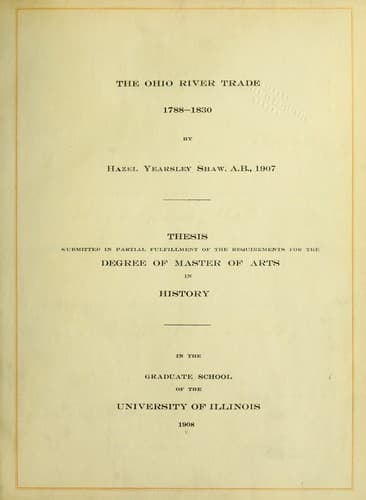
The Ohio River Trade, 1788-1830Shaw, Hazel Yearsley
History
The Ohio River Trade, 1788-1830
Shaw, Hazel Yearsley
Ohio River -- History; Ohio River Valley -- History
Floating stores were also to be seen on the Ohio. Cuming says, "On
returning to our boat we found a floating store at the landing.
It was a large square flat-roofed, and fitted with shelves and
counter, and containing a various assortment of merchandise. They
were dropping down the river, stopping occasionally wherever they
could find a market for their goods."[30]
Schultz, in his account of his journey, devotes one entire letter
to a very interesting account of the craft upon the Ohio in 1807.
The smallest were the canoes, then, the pirogues, sufficient to
carry from twelve to fifteen barrels of salt. The skiffs varied
from five hundred to twenty thousand pounds weight burthen, the
larger ones being known as batteaux. Arks were not much in use on
the Ohio, at that time.[31] Kentucky boats were of oblong form,
varying from ten to fourteen feet in breadth, and from twenty
to fifty feet in length, and were sided and roofed in. The roof
answered the purpose of a main and quarter deck, and the boat was
steered by a long pole, the whole length of the boat.[32] The boat
usually carried from one to three hands, as it was necessary, when
heavily loaded, to use the oars to keep the boat in the middle of
the river. New Orleans boats were built upon the same model, but
were generally much larger and stronger, and built with an arched
roof fore and aft. The largest of these boats could carry four
hundred and fifty barrels of flour.[33] The timbers or knees were
built upon a small keel, three inches deep, and four or five in
width,--hence the name keel boat. The keel received the first shock
of any obstruction in the navigation.
Schenectady boats were usually built from forty to eighty feet in
length, and seven to nine in width--the largest kind requiring
one hand to steer, and two to row in descending the Ohio.
These boats carried as much as one hundred barrels of salt. In
ascending the stream six or eight hands were needed to make any
considerable progress.[34] "The best kind of boats on the Ohio
are called barges."[35] These boats were steered by a rudder, and
when descending with the current were not so easily twisted and
turned as a keel boat. The barges carried from forty to sixty
thousand weight, and required four hands besides the helmsman to
descend the river; to return with a loading, from eight to twelve
became necessary. "Barges as well as keel boats, generally carry
a moveable mast a-mid-ships--whenever the wind will permit, set a
square sail, and some few top sails."[36]
The prices of these boats were as follows: Canoes from $1 to $3;
pirogues from $5 to $20; large skiffs or batteaux from $20 to $50;
arks $1 a foot in length; Kentucky and New Orleans boats from $1 to
$1.50 a foot; Keel boats from $2.50 to $3 a foot; and barges from
$4 to $5 a foot.[37]
Public-domain text, read in full here on John Shaqi.
Reviews
Reviews
No reviews yet
Be the first to share your thoughts on this work.
Join the Discussion
Join the discussion
Sign in to leave a comment or review.
Sign InorCreate an account