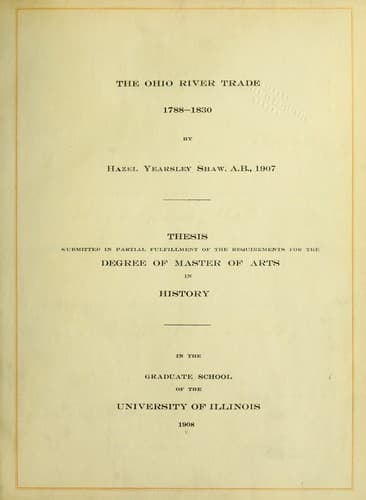
The Ohio River Trade, 1788-1830Shaw, Hazel Yearsley
History
The Ohio River Trade, 1788-1830
Shaw, Hazel Yearsley
Ohio River -- History; Ohio River Valley -- History
Most of the strange boats, to be seen upon the Ohio River, after
1794, were broken up and sold at the end of the voyage, the produce
disposed of, and the settler returned to his farm, a thousand or
fifteen hundred miles, as best he could.[38]
The building of larger craft, was undertaken at some of the river
towns. In the year 1800, some of the enterprising men of Marietta,
formed a company for building a small vessel, and actually built,
rigged, and loaded with produce, a brig of 104 tons, named the St.
Clair. She cleared from Marietta in 1801, went to New Orleans, from
there to Havana, and then to Philadelphia where she was consigned
and finally sold.[39] The St. Clair was the first rigged vessel
ever built on the Ohio River.[40] From this time until 1808, not
less than twenty ships, brigs, and schooners, from 150 to 450 tons
burthen, were built at Marietta, besides some of Mr. Jefferson's
gun boats, two or three of whose number were lost in attempting
to cross the Falls of the Ohio when the water was too low.[41] In
1807 Schultz says that there were three ships of about 300 tons
burthen each, and two large brigs, besides smaller craft, on the
stocks at Marietta.[42] The price of ship building in Marietta was
fifty dollars a ton, rigged and equipped completely for sea.[43]
Ellicott in his Journal for the years 1796-1800, says that vessels
have been built and sent to the West Indies.[44] Large boats had
been built at Elizabethtown on the Monongahela, before 1803, and
sent to the West Indies.[45] Previous to 1807, about twelve brigs
and schooners had been launched at Pittsburg;[46] and brigs had
been built at Frankfort and sent down the Kentucky, Ohio, and
Mississippi Rivers.[47]
The Falls of the Ohio were very dangerous to strangers unacquainted
with the navigation. In 1807 pilots might be procured who would
conduct travelers over in safety. Two dollars per boat was charged
for this service.[48]
FOOTNOTES:
[1] Michaux, F. A., Travels, Early W. Travels, III., 191. Used by
Pittsburg traders to convey haberdashery goods, more especially tea
and coffee, to settlers on the River.
[2] Hall, J., The West, 110-111.
[3] Hildreth, S. P., Memoirs, 422.
[4] Hall, J., The West, 111-113.
[5] Ibid., 10.
[6] Latrobe, C. J., Rambler in North America, I., 103.
[7] Michaux, F. A., Travels, Early W. Travels, III., 159-160.
[8] Hall, J., The West, 113.
[9] Ibid, 113-114,
[10] Burnet, J., Notes, 399-400,
[11] Ibid., 400.
Collot, V., Journey, I., 39. "The carriage of an hundred weight
from Philadelphia to Pittsburg is from $8 to $10, and from
Baltimore $7 or $8.
Collot, V., Journey, II., 198. "The carriage from Philadelphia
to the Illinois is 12 piastres the hundred weight--the expense
from Baltimore are the same. The expense from New Orleans to the
Illinois, is 5 piastres the French hundred weight."
Public-domain text, read in full here on John Shaqi.
Reviews
Reviews
No reviews yet
Be the first to share your thoughts on this work.
Join the Discussion
Join the discussion
Sign in to leave a comment or review.
Sign InorCreate an account