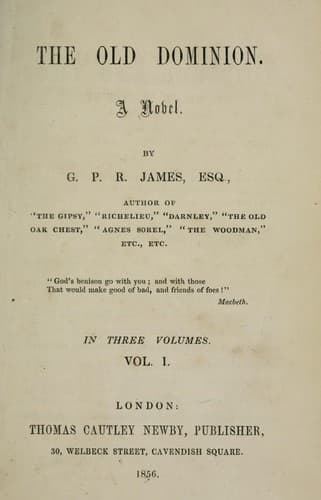
The Old DominionJames, G. P. R. (George Payne Rainsford)
General
The Old Dominion
James, G. P. R. (George Payne Rainsford)
Southampton Insurrection, 1831 -- Fiction
I felt somewhat revengeful, and I almost longed to try if I could not
make the boasting little beauty know something of the power she
scoffed at. But just then Mr. Thornton came up, and began jesting with
his fair relation upon her morning reveries beside the stream.
"I saw you, Bessy," he said; "and if I had met with Mr. Howard, I
should have sent him down to try if he could not break up your
visions."
"I dare say he would have succeeded," she answered; "for he has been
amusing me here with some of the driest subjects in the world."
"Of what kind, little hypocrite?" asked Mr. Thornton.
"Arithmetic--arithmetic," she replied gaily. "As, for example, how
many ganders' heads are required to make one goose's. But, here comes
Mr. Hubbard slowly down stairs; and there is Mr. Alsiger's back at the
end of the passage; so I had better go in to get breakfast ready, for
Lou won't be down this hour."
And away she ran, casting her parasol into a cane seat in the hall.
Mr. Thornton paused, and fell into a reverie for a moment or two,
which he concluded by saying, as if to himself,--
"The poets are wrong."
I knew not what he meant, of course; and whether those few words
directed his and my thoughts, or not, I cannot tell; but at breakfast
we got into a discussion of poets and poetry.
"It is wonderful," Mr. Thornton observed, after a few other remarks
upon the subject, "that with all the superabundant energies which this
country possesses, and all the imagination which she expends upon
other themes, we have, as yet, produced no very remarkable poet."
I ventured to say that I did not think it wonderful; and, of course,
there was a call for my reasons.
"In the first place," I replied, "the energies of the people have
other objects, and those principally material. In the next place, the
imaginative faculty finds other occupation."
"How so, how so?" asked Mr. Hubbard.
"In orations, speeches, declamations," I answered, and then continued,
with a smile, "perhaps I might add, in finding causes for offence in
the acts of other nations; and without offence, let me say, Mr.
Alsiger, in religious exercises which perhaps touch the fancy rather
than inform the heart."
"Too true, too true!" said the good clergyman, with a sigh.
"Then again," I continued, "poetry is generally the offspring of
leisure. Now, there is--at least it seems so to me--no such thing as
leisure in America, and----"
"Excuse me," interrupted Mr. Thornton, laughing; "we have plenty of
leisure in Virginia, if we did but know what to do with it. But you
were going to add something."
"I was merely going to remark, as a matter of history, that poetry
rarely flourishes in republics. Monarchies are its congenial soil. It
is a flower that requires a hot-house."
"Oh, heresy, heresy!" cried Bessy Davenport. "What! can such noble and
inspiring things as freedom and independence have no power to awaken
great thoughts, or even to clothe them in immortal verse?"
Public-domain text, read in full here on John Shaqi.
Reviews
Reviews
No reviews yet
Be the first to share your thoughts on this work.
Join the Discussion
Join the discussion
Sign in to leave a comment or review.
Sign InorCreate an account