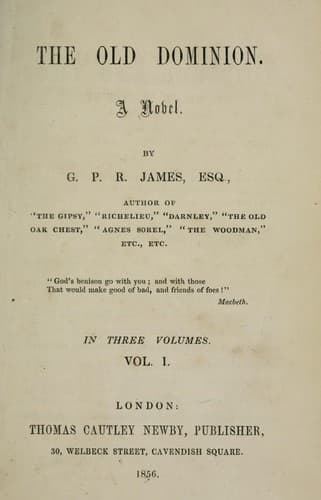
The Old DominionJames, G. P. R. (George Payne Rainsford)
General
The Old Dominion
James, G. P. R. (George Payne Rainsford)
Southampton Insurrection, 1831 -- Fiction
"Your pardon, fair lady," I answered; "but you are assuming the
premises. Freedom and independence, I would contend, can exist as
well--nay, better--in a well-ordered monarchy than in any republic.
The tyranny of a number--or of a majority, if you please,--is always
more terrible than the tyranny of an individual--the tyranny of public
opinion, more potent than the rule of a monarch, and more likely to be
wrong. But all that is beside the question. I merely spoke of an
historical fact. With an exception here and there, you find no very
remarkable poets under republics: many under monarchs."
"I have never considered the facts," said Mr. Hubbard; "but let us
test it, my dear sir; and to begin with the beginning, there is Homer.
It is very true he lived under a whole host of kings, if there is any
faith at all to be placed in the tales regarding him; but what say you
to the whole batch of Athenian poets?"
"That they lived under archons, which were tantamount to kings," I
answered. "And then, again, Pindar; he could not even endure the sort
of mitigated republicanism of Greece, but fled to the court of a
tyrant. Virgil, Horace--every great Roman poet, in short--flourished
about the time of the emperors. In England, Gower, Chaucer,
Shakespeare, all lived, and wrote, under monarchs; and it has even
seemed to me that the greater the despotism, the better the poet."
"But Milton! Milton!" cried Mr. Alsiger; "he was a republican in heart
and spirit."
"But he never wrote a line of poetry," I answered, "under the Long
Parliament, or at least very few. Not much did he write under the
tyranny of Cromwell; and all his best compositions date from the reign
of one or the other of the Charleses."
"But Dante," said Mr. Thornton; "I cannot indeed, discuss his merits
with you; for I have well nigh forgotten all the Italian I knew thirty
years ago. He, however, lived under a republic."
"He is an exception," I replied; "although I can hardly look upon the
constitution of Florence, at that time, as a republican form of
government. It was rather oligarchical; and even then, shadows of an
emperor and a pope overhung it. But Ariosto, Tasso, Boccaccio, and all
the rest of the Italian poets were the mere creatures of courts. The
same is the case with France, although she never had but two poets;
and the same with Germany."
"May it not be," asked Mr. Hubbard, "that monarchies, up to the
present day, have been much more frequent than republics?"
"Perhaps so," I answered; "yet it is very strange that we find no poet
of mark actually springing from a pure republic. Where is the Swiss
poet? although every accessory of country, history, climate, and
natural phenomena seems to render the very air redolent of poetry."
Bessy Davenport sprang up from the table, shaking her head at me, with
a laugh, and saying,--
"I abominate your theory. You are worse than an abolitionist; and if
you preach such doctrines here, we will have you tried for high
treason."
Public-domain text, read in full here on John Shaqi.
Reviews
Reviews
No reviews yet
Be the first to share your thoughts on this work.
Join the Discussion
Join the discussion
Sign in to leave a comment or review.
Sign InorCreate an account