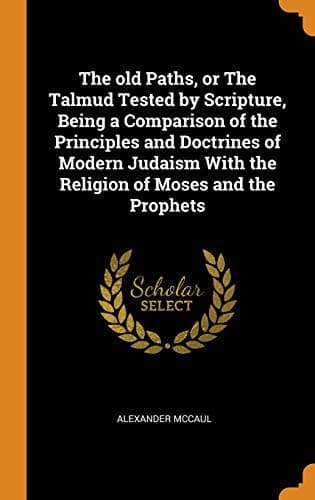
The old paths, or the Talmud tested by Scripture: Being a comparison of the principles and doctrines of modern Judaism with the religion of Moses and the prophetsMcCaul, Alexander
Religion
The old paths, or the Talmud tested by Scripture: Being a comparison of the principles and doctrines of modern Judaism with the religion of Moses and the prophets
McCaul, Alexander
Judaism -- Works to 1900
“A woman may fill a pot with meat, though she wants only one piece. A
cook may fill a boiler with water, though he wants only the least
quantity. A woman may fill an oven with bread, though she want only one
loaf, for when the oven is full, the bread bakes better. A man may salt
a great many pieces of meat at once, although he require only one piece;
and so with similar things.” (Hilchoth Jom. Tov. c. i. 10.) Now this is
plainly an evasion of what is considered a Divine command. In like
manner the oral law forbids the preparing of food for Gentiles.
אין אופין ומבשלין ביום טוב כדי להאכיל גוים או כלבים שנאמר הוא לבדו יעדו
יעשה לכם לכם ול לגוים לכם ולא לכלבים ׃
“It is unlawful to bake or to cook on a holy day, in order to feed
Gentiles or dogs; for it is said, ‘That only may be done for you.’ (Exod
xii. 16.) ‘For you,’ and not for Gentiles. ‘For you,’ and not for dogs.”
(Ibid.) The principle of this decision may lead to several difficulties:
first, a Jew may have Gentiles in his employ and service whom he boards,
what is he to do then? This difficulty he may get over in the manner
just mentioned, by having more cooked than he wants, then it is lawful
for the Gentile to eat of the surplus. But suppose a Gentile and a Jew
had a beast in partnership, and either wished to have it slaughtered on
the holy day, is it lawful for a Jew to slaughter it? According to the
above decision, it would appear not, for it is preparing food to feed a
Gentile; but the rabbies have found out a reason for evading the
command.
בהמה שחציה של גוי וחציה של ישראל מותר לשחטו ביום טוב שאי אפשר לאכול ממנה
כזית בשר בלא שחיטה ׃
“A beast which partly belongs to a Gentile and partly to an Israelite,
may lawfully be slaughtered on a holy day, for it is impossible to eat
the size of an olive of the meat, if it be not slaughtered by a Jew.”
(Ibid.) This, also, is nothing more nor less than an evasion. But now
suppose that a Jew finds on a holy day, and after he has eaten his
meals, that a beast belonging to him is likely to die, and that
therefore he is likely to lose it altogether, what is he to do? The oral
law lays it down that it is unlawful to slaughter for the following day,
and yet if it die without slaughtering, it must be totally unlawful to
eat. In this case there is a saving clause which removes the difficulty.
מי שהיתה לו בהמה מסוכנת לא ישחוט אותה ביום טוב אלא אם כן יודע שיוכל
לאכול ממנה כזית צלי מבעוד יום , כדי אלא ישחוט ביום טוב מה שיאכל בחול ׃
Public-domain text, read in full here on John Shaqi.
Reviews
Reviews
No reviews yet
Be the first to share your thoughts on this work.
Elsewhere in the archive
Join the Discussion
Join the discussion
Sign in to leave a comment or review.
Sign InorCreate an account