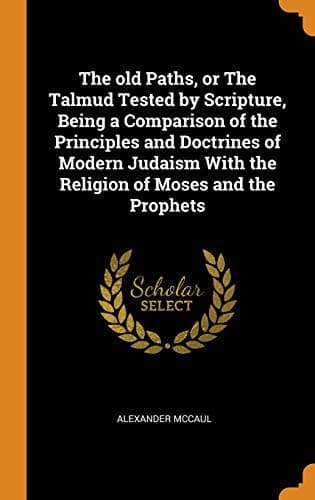
The old paths, or the Talmud tested by Scripture: Being a comparison of the principles and doctrines of modern Judaism with the religion of Moses and the prophetsMcCaul, Alexander
Religion
The old paths, or the Talmud tested by Scripture: Being a comparison of the principles and doctrines of modern Judaism with the religion of Moses and the prophets
McCaul, Alexander
Judaism -- Works to 1900
It appears from the undisguised acknowledgments of the New Testament,
that the doctors and rabbies of the Jews, the Pharisees, and scribes,
were the implacable enemies of Jesus of Nazareth, and that they were the
main instruments in effecting his death. The modern Jews consider this
fact as a sufficient apology for their rejection of his claims to the
Messiahship. They take it for granted that the great and learned men of
that day were also good men, and that they had valid reasons for their
conduct. They think if Jesus of Nazareth had been the true Messiah, that
the Sanhedrin, the great Jewish council of the time, would have
acknowledged him, and conclude that, as they rejected him, he cannot be
the true Messiah. The New Testament, on the contrary, accounts for their
unbelief by plainly telling us, that they were bad men; and that they
were enemies to the Lord Jesus, because he told them the truth, and
exposed their hypocrisy. Now, which of these two representations accords
with the truth? Were the scribes and Pharisees, those great advocates of
the _oral law_, תורה שבעל פה, good men or bad men? The readers of our
first number will be in some degree qualified to answer this question.
Could those be good men who profanely talked of the lawfulness of
killing an unlearned man, and who contemptuously compared the wives and
daughters of the unlearned to “vermin and beasts?” If they could talk
with levity of “rending like a fish” an unlearned man, one of their own
brethren who had never done them any harm, what were they likely to do
with one who exposed their wickedness, and boldly told them that they by
their traditions made void the law of God? The very fact, that Jesus of
Nazareth was put to death by such men, is presumptive evidence, that he
was a good man, and that his claims were just. But, however that be, it
is worth while to inquire into the charges, which the New Testament
brings against these learned men, and to see whether they are
substantiated by the memorials of their character and spirit, which they
themselves have left us in their laws. One of the charges preferred
against them is, that they were ambitious men, covetous of worldly
honour, and loving the pre-eminence. “But all their works they do to be
seen of men; they make broad their phylacteries, and enlarge the borders
of their garments. And love the uppermost rooms at feasts, and the chief
seats in the synagogues, and greetings in the markets, and to be called
of men, Rabbi, Rabbi.” (Matt. xxiii. 5-7.) Now, is this charge true?
Does the oral law justify this assertion, or does it prove, on the
contrary, that the enemies of Jesus were humble, pious men, whose piety
serves as a warrant for the uprightness of their conduct in their
treatment of the Lord Jesus? Let the reader judge from the following
laws which these men framed with respect to themselves. In the first
place they claim for themselves more honour and reverence than is due to
a man’s own parents:—
Public-domain text, read in full here on John Shaqi.
Reviews
Reviews
No reviews yet
Be the first to share your thoughts on this work.
Join the Discussion
Join the discussion
Sign in to leave a comment or review.
Sign InorCreate an account