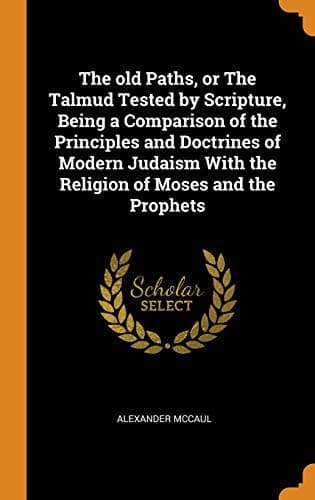
The old paths, or the Talmud tested by Scripture: Being a comparison of the principles and doctrines of modern Judaism with the religion of Moses and the prophets — John Shaqi
The old paths, or the Talmud tested by Scripture: Being a comparison of the principles and doctrines of modern Judaism with the religion of Moses and the prophetsMcCaul, Alexander
Religion
The old paths, or the Talmud tested by Scripture: Being a comparison of the principles and doctrines of modern Judaism with the religion of Moses and the prophets
McCaul, Alexander
Judaism -- Works to 1900
כשם שאדם מצווה בכבוד אביו וביראתו כד הוא חייב בכבוד רבו וביראתו יותר
מאביו וכו׳ ׃
“As a man is commanded to honour and fear his father, so he is bound to
honour and fear his Rabbi more than his father; for his father has been
the means of bringing him into the life of this world, but his Rabbi,
who teaches him wisdom, brings him to the life of the world to come.”
(Hilchoth Talmud Torah, c. 5.) This general rule is bad enough, but the
particulars are still worse. “If a man should see something that his
father has lost, and something that his Rabbi has lost, he is first to
return what his Rabbi has lost, and then to return that which belongs to
his father. If his father and his Rabbi be oppressed with a load, he is
first to help down that of his Rabbi, and then that of his father. If
his father and his Rabbi be in captivity, he is first to ransom his
Rabbi and afterwards his father unless his father be the disciple of a
wise man (_i.e._, learned), in which case he may ransom his father
first.” How fearful is this doctrine! A man is to see his father, the
author of his existence, the guardian of his infancy, who has laboured
for his support, and watched over him in the hour of sickness, he is to
see this friend, to whom, under God, he owes everything, pining away in
the bitterness of captivity, and yet, when he has got the means of
restoring him to liberty and his family, he is to leave him still in all
his misery, and ransom the Rabbi; where is this written in the Old
Testament? “Honour thy father and thy mother,” is there the first
commandment that follows after our duty to God, and the first movement
of natural affection. But this Rabbinical doctrine silences the voice of
nature, and makes void the law of God. What is the doctrine of the New
Testament here? “If any provide not for his own, and specially for those
of his own house, he hath denied the faith, and is worse than an
infidel.” (1 Tim. v. 8.) The disciples of the Lord Jesus Christ never
claimed for themselves any honour like this. In the passage just cited,
they plainly declare that the first, in the circle of duties to men, is
the duty to our own flesh and blood. And the only case in which the New
Testament permits a deviation from this rule, is that where the same
exception is made in the law of Moses, when love to parents would
interfere with love to God. “If any man come to me and hate not his
father and mother, and wife and children, and brethren and sisters, yea,
and _his own life also_, he cannot be my disciple.” (Luke xiv. 26.) Here
father and mother, and kindred, are put in one category with a man’s own
life, in order to show that there is but one case in which the natural
ties of blood may be overlooked, and this is when the service of God
requires it. As it is also written in the law of Moses, “If thy brother,
the son of thy mother, or thy son, or thy daughter, or the wife of thy
bosom, or thy friend who is as thine own soul, entice thee secretly,
Public-domain text, read in full here on John Shaqi.
Reviews
Reviews
No reviews yet
Be the first to share your thoughts on this work.
Join the Discussion
Join the discussion
Sign in to leave a comment or review.
Sign InorCreate an account