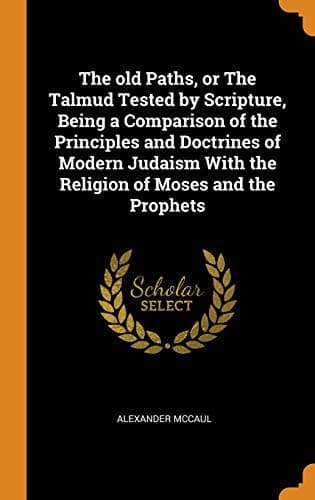
The old paths, or the Talmud tested by Scripture: Being a comparison of the principles and doctrines of modern Judaism with the religion of Moses and the prophetsMcCaul, Alexander
Religion
The old paths, or the Talmud tested by Scripture: Being a comparison of the principles and doctrines of modern Judaism with the religion of Moses and the prophets
McCaul, Alexander
Judaism -- Works to 1900
“In the hour when Moses ascended up on high, the ministering angels said
before God, O Lord of the world, what business has he that is born of a
woman amongst us? He replied, He is come to receive the law. They
answered, This most desirable treasure, which has been treasured up from
the six days of creation, six hundred and seventy-four generations
before the world was created, dost thou now wish to give it to flesh and
blood—what is man that thou art mindful of him, and the son of man that
thou visitest him? O Lord, our Lord, how excellent is thy name in all
the earth, who hast set thy glory above the heavens. The Holy One said
to Moses, Give them an answer. He replied, O Lord of the world, I am
afraid, lest they burn me with the breath of their mouth. He said, Lay
hold on the throne of my glory and give them an answer, for it is said,
‘He that holdeth the face of his throne, he spreadeth his cloud over
him.’ (Job xxvi. 8, 9.) Rabbi Nahum says, This teaches us that the
Almighty spread some of the glory of the Shechinah and his cloud over
him. He then said, Lord of the world, what is written in the law that
thou art about to give me? ‘I am the Lord thy God that brought thee out
of Egypt.’ He then said, Did ye ever go down into Egypt and serve
Pharaoh—why, then, should ye have the law? Again, what is written
therein? ‘Thou shalt have none other God.’ He then asked them, Do ye
then dwell amongst the uncircumcised, that ye should commit idolatry?
Again, what is written? ‘Remember the Sabbath-day to sanctify it.’ Do
ye, then, do any work, so as to need rest? Again, what is written? ‘Thou
shalt not take the name of the Lord,’ &c. Have ye, then, any business
that would lead to this sin? Again, what is written? ‘Honour thy father
and mother.’ Have ye, then, got any father and mother? Again, what is
written? ‘Thou shalt not kill, thou shalt not commit adultery, thou
shalt not steal.’ Have ye, then, got envy or the leading principle that
would lead to these sins? Immediately they praised the Holy One, blessed
be He,” &c. (Shabbath, fol. 88, col. 2, &c.) It is not necessary to
prove that this account is a fiction. The absurdity of the whole scene
is too palpable. To what purpose should the angels wish for the law of
Moses, or be envious of men to whom it was given? Is it possible that
the spirits that minister before the throne of God, were not able to see
the unsuitableness of the law for them, until Moses pointed it out to
their consideration? We think that if this scene had ever taken place,
Moses might have given them other passages of the law much more to the
purpose; but it is plainly a fable invented by the designing, and
propagated by the credulous. These two stories then, that Moses received
the oral law, and that he disputed with the angels in heaven, come to us
upon one authority; they are both circumstances in one event; and the
fabulousness of the one takes away all credit from the other. The oral
Public-domain text, read in full here on John Shaqi.
Reviews
Reviews
No reviews yet
Be the first to share your thoughts on this work.
Elsewhere in the archive
Join the Discussion
Join the discussion
Sign in to leave a comment or review.
Sign InorCreate an account