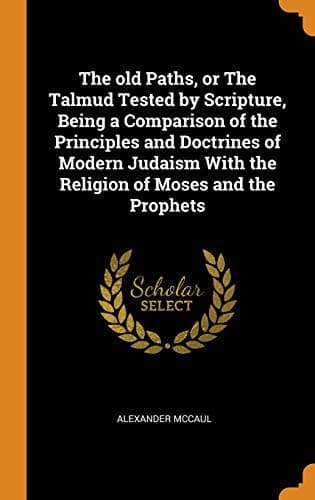
The old paths, or the Talmud tested by Scripture: Being a comparison of the principles and doctrines of modern Judaism with the religion of Moses and the prophetsMcCaul, Alexander
Religion
The old paths, or the Talmud tested by Scripture: Being a comparison of the principles and doctrines of modern Judaism with the religion of Moses and the prophets
McCaul, Alexander
Judaism -- Works to 1900
law rests solely upon the testimony of its transmitters, but here these
persons are convicted of transmitting palpable falsehood: their
testimony to the oral law is therefore useless, and the whole fabric of
tradition falls. This one fable is sufficient, but the readers will
remember that this is only one of a considerable number selected from
the Jewish Prayer-book. To extract all similar stories from the Talmud
would be to make some folio volumes. The Prayer-book, however, gives
enough to invalidate the testimony of the Scribes and Pharisees, and to
incapacitate them for ever from appearing as witnesses. Perhaps some one
will say, But they are also the witnesses for the written law, and
therefore, if we reject their testimony, we must give up the written law
also. But this is not so. For _that_ we have other testimony—we have
that of the Jewish nation, of which the Scribes and Pharisees were at
first only an inconsiderable portion. We have the testimony of Jesus and
his disciples, the great opposers of the oral law. We have the testimony
of the predictions, which we behold still accomplishing. We have the
whole internal evidence, so that if there never had been Pharisees, the
evidence for the written law would be just as valid. As it is, the
contrast which the written law presents, when compared with the oral
law, furnishes in itself a strong evidence of its truth and
authenticity. The written law is simple, sober, dignified. The oral law
is multifarious, extravagant, absurd. The oral law is poison—the written
law is the antidote. The oral law is a counterfeit, which proves the
existence of the genuine coin. Men who receive both on the sole
authority of the rabbies may, when they find the falsehood of the one,
reject the other also, but this can never be the case with those who
calmly compare and weigh the two in the balance of right reason.
Public-domain text, read in full here on John Shaqi.
Reviews
Reviews
No reviews yet
Be the first to share your thoughts on this work.
Elsewhere in the archive
Join the Discussion
Join the discussion
Sign in to leave a comment or review.
Sign InorCreate an account