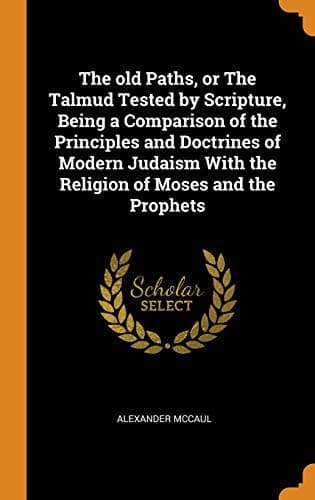
The old paths, or the Talmud tested by Scripture: Being a comparison of the principles and doctrines of modern Judaism with the religion of Moses and the prophetsMcCaul, Alexander
Religion
The old paths, or the Talmud tested by Scripture: Being a comparison of the principles and doctrines of modern Judaism with the religion of Moses and the prophets
McCaul, Alexander
Judaism -- Works to 1900
We now dismiss these Talmudic fables for the present. We have proved by
instances that the oral law abounds with such. We have proved by
extracts from the Prayers of the synagogue, that these fables form a
part of the faith of all rabbinical Jews. We have, therefore, proved
that the inventors of these fables attained their object. They have
succeeded in deceiving the great majority of their countrymen. It is for
the Jews of the present day to consider whether these extravagant
fictions are still to be handed down to unborn generations—still to
appear as a reproach upon Israel’s understanding—still to disfigure and
dishonour the public worship of the chosen people. Former generations
may have handed them down in ignorance, and be therefore partly
excusable. But in the present day there is a large body of Jews here in
England who are fully convinced that these legends are false: it is the
duty, the sacred duly, of all such to protest against their further
propagation. If they do not, they make themselves accomplices in the
guilt of those who invented them, and responsible for all the injury,
temporal and spiritual, which the propagation of such error may inflict
upon their brethren and their posterity. But whatever course they may
pursue, the existence of these fables shows that the oral law itself is
altogether an invention of men, and proves that Jesus of Nazareth
conferred a great and substantial benefit on the nation and on mankind,
by vindicating and preserving for us the unadulterated truth of God’s
written Word.
These fables prove further, that there is neither weight nor value in
the sentence which these men pronounce against the Lord Jesus Christ. It
is the sentence of those who did not scruple to falsify and pervert the
law of God; it is the testimony given by the notorious inventors and
propagators of fables, and cannot be received by any one competent to
weigh evidence. Fables of any kind will invalidate testimony, but
religious fables utterly incapacitate their inventors and propagators
from being admitted as witnesses at all. The man who will venture to
tamper with sacred history, either by adding to, or diminishing from,
its records, clearly shows that he has lost all reverence for truth, and
all sense of the divine character, as a vindicator of truth and a
punisher of falsehood. The man who trifles with sacred facts, cannot be
regarded as a witness at all in those which he considers profane or
common. When, therefore, the Talmudists, or the wise men of his time,
bear witness against Jesus of Nazareth, whom they hated, we must
remember that they have been convicted of false witness again and again
in the case of Moses, whom they professed to love. Their testimony is
therefore a nullity, and if we wish to examine the claims of Jesus of
Nazareth, we must look elsewhere for the data which are to form the
basis of our judgment.
No. XXII.
RABBINIC MAGIC.
Public-domain text, read in full here on John Shaqi.
Reviews
Reviews
No reviews yet
Be the first to share your thoughts on this work.
Elsewhere in the archive
Join the Discussion
Join the discussion
Sign in to leave a comment or review.
Sign InorCreate an account