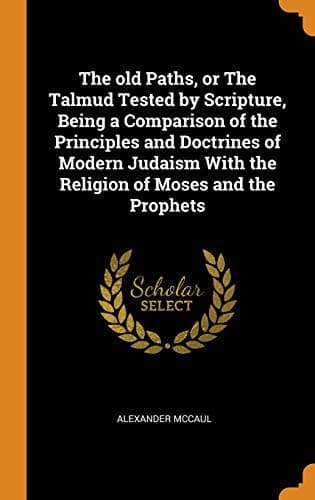
The old paths, or the Talmud tested by Scripture: Being a comparison of the principles and doctrines of modern Judaism with the religion of Moses and the prophetsMcCaul, Alexander
Religion
The old paths, or the Talmud tested by Scripture: Being a comparison of the principles and doctrines of modern Judaism with the religion of Moses and the prophets
McCaul, Alexander
Judaism -- Works to 1900
not ask counsel of the Lord, for in the second Temple the Urim and
Thummim, and the ark of the covenant, were wanting; the miraculous
power, therefore, did not exist, and for this very reason the sentence
of the priests, during the whole period of the second Temple, was only
fallible, like that of other men, and, therefore, not binding, and
consequently of no force as an argument against the Messiahship of the
Lord Jesus Christ. The above passage, therefore, from the 17th of
Deuteronomy, is of no use to the Rabbinical Jews, it does not prove the
infallibility of the priests in the second Temple, and is still less
applicable for sanctioning the traditions of the oral law, and the
extravagant claims of the Rabbies. Having given this passage the
consideration it deserves, we now return to the laws which the Rabbies
have made in favour of themselves, and for their own honour. We consider
that the two passages of the oral law already quoted, prove that the New
Testament gives a fair delineation of their character. When men, without
any warrant from God’s Word, claim for themselves the same degree of
reverence which is due to God, it must be admitted that they are
vainglorious and wicked in no ordinary degree. But it is possible to
descend to particulars:—For instance, our Lord says, that these men
“loved greetings in the market-places, and to be called of men, Rabbi,
Rabbi.” Now one of the laws, still extant, forbids a man, when speaking
of his Rabbi, to call him by name:—
אסור לו לתלמיד לקרות לרבו בשמו ואפילו שלא בפניו ,
“It is forbidden to a disciple to call his Rabbi by name, even when he
is not in his presence.” Another law, still extant, prescribes the
formula of greeting or salutation:—
ולא יתן שלום לרבו או יחזיר לו שלום כדרך שנותנים לריעים ומחזירים זה לזה
אלא שוחה לפניו ואומר לו ביראה וכבוד שלום עליך רבי ׃
Public-domain text, read in full here on John Shaqi.
Reviews
Reviews
No reviews yet
Be the first to share your thoughts on this work.
Join the Discussion
Join the discussion
Sign in to leave a comment or review.
Sign InorCreate an account