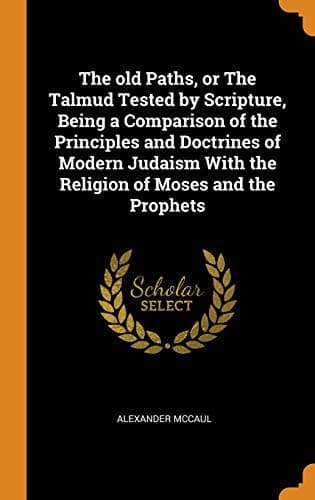
The old paths, or the Talmud tested by Scripture: Being a comparison of the principles and doctrines of modern Judaism with the religion of Moses and the prophets — John Shaqi
The old paths, or the Talmud tested by Scripture: Being a comparison of the principles and doctrines of modern Judaism with the religion of Moses and the prophetsMcCaul, Alexander
Religion
The old paths, or the Talmud tested by Scripture: Being a comparison of the principles and doctrines of modern Judaism with the religion of Moses and the prophets
McCaul, Alexander
Judaism -- Works to 1900
If any of our readers should think that the design of these papers is to
represent the oral law as a system of unmixed evil, we beg to assure
them that they are mistaken. We are fully aware that a system based on
the law and the prophets, must and does contain much that is good and
worthy of admiration. Of this nature is the general command to all
Israelites to study the law, which is as follows:—“Every man of Israel
is bound to study the law. Whether he be poor or rich, healthy or
unhealthy, young or old, yea, though he live upon alms, and beg from
door to door, and though he have a wife and children, he is bound to set
apart a fixed time for the study of the law, by day and by night, as it
is written, ‘Thou shalt meditate therein by day and by night,’” And
again, the maxim, “Every one that is bound to learn is also bound to
teach;” and that, “therefore, a man is bound to teach his son and his
son’s son,” &c., is in accordance with the plain command of God, and is
therefore good. But the explanation and development of these good
principles shows that the system itself is radically bad, and therefore
cannot be from God. No one will deny that the Rabbies are right in
asserting the obligation resting on every Israelite to study the law:
but they are wrong in their explanation of what the law is. Immediately
after the above good command, the oral law goes on to say, “Every one is
bound to divide the time of his study into three parts: one-third to be
devoted to the written law; one-third to Mishna; and one-third to
Gemara:” so that the written law of God is to have only half as much
attention as the traditions of men. This is bad enough. But the Rabbies
do not stop here. They go on to say, that this third of attention is
only required when a man begins to study, but that when he has made
progress, he is to read the law of God only at times, and to devote
himself to Gemara.
בד׳׳א בתחלת תלמודו של אדם אבל כשיגדיל בחכמה ולא יהא צריך לו ללמוד תורה
שבכתב ולא לעסוק תמיד בתורה שבעל פה יקרא בעתים מזומנים תורה שבכתב ודברי
השמועה כדי שלא ישכח דבר מדברי דיני תורה ויפנה כל ימיו לגמרא ׃
“What has been said refers only to the beginning of a man’s learning,
but as soon as a man becomes great in wisdom, and has no need of
learning the written law, or of labouring constantly in the oral law,
let him at fixed times read them, that he may not forget any of the
judgments of the law, _but let him devote all his days to Gemara_.” It
is to be observed that “oral law” is here taken in a limited sense, as
referring to the expositions of the written law, or, as Rabbi Joseph
Karo[2] explains it, the Mishna; and Gemara signifies the legal
decisions which are inferred by a process of reasoning, and to this
third topic of Jewish theology the Israelites are commanded to give the
chief of their time and attention, rather than to the written Word of
God.
Public-domain text, read in full here on John Shaqi.
Reviews
Reviews
No reviews yet
Be the first to share your thoughts on this work.
Join the Discussion
Join the discussion
Sign in to leave a comment or review.
Sign InorCreate an account