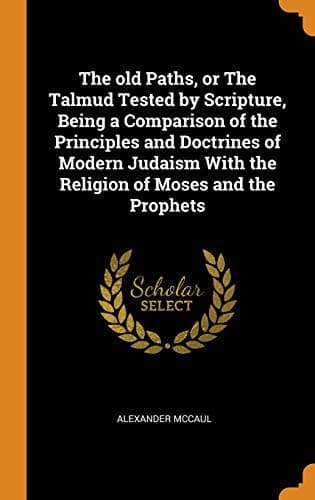
The old paths, or the Talmud tested by Scripture: Being a comparison of the principles and doctrines of modern Judaism with the religion of Moses and the prophetsMcCaul, Alexander
Religion
The old paths, or the Talmud tested by Scripture: Being a comparison of the principles and doctrines of modern Judaism with the religion of Moses and the prophets
McCaul, Alexander
Judaism -- Works to 1900
“Whosoever does any work on the Sabbath, even though he does not do it
for the sake of the work itself, is nevertheless guilty. How so? If, for
instance, a man extinguishes a lamp, because he wants the oil or the
wick, and wishes that it should not waste, nor be burned, or that the
earthenware part of the lamp should not be cracked; inasmuch as the
extinguishing is work, and his intention was to extinguish it: although
the mere act of extinguishing it was not the ultimate object, but on the
contrary, the saving of the oil or the wick, or the earthen lamp, he is,
nevertheless, guilty. And in like manner, whosoever, removes thorns a
distance of four ells in a public place, or whosoever extinguishes coals
to prevent the public from being injured, is guilty: although the
ultimate object was not the extinguishing nor the moving, but he simply
intended to prevent the injury, he is guilty, and so in all similar
cases.” (Ibid.) If this were the law of the land, and the executive were
in the hands of Talmudistic zealots, the peace of the world would be at
an end. The poor man could not be happy, when he saw his little property
wasting; and the humane man would either be made miserable at the
thought of being able to prevent much injury, and yet not doing it, or
would have to expose himself to the danger of a cruel and ignominious
death. We know enough of the general character of the Jewish nation to
believe that there are amongst them those who would brave the danger,
whose generous hearts would rise above personal considerations, but how
dreadful would be the consequences! A man of a tender heart, the father
of a family, would be induced, by the best of feelings, to save his
fellow-men from injury. He would return to his family, and tell them how
God had given him an opportunity of doing good. The family worthy of
such a father would rejoice to hear the information, but the sequel of
his story would turn their joy into mourning. He would have to tell them
that ignominious death would be the consequence, and that because he
dared to do an act of charity, and to love his brother as himself, the
morrow would see his wife a widow and his children orphans. But suppose,
that when he performed the act, he had been attended by two of his sons,
now grown up, and zealots for the oral law—that they had warned him, and
then became his accusers, as they must, if firm believers in Talmudic
religion, he would have the additional pangs of seeing his own flesh and
blood as the foremost of his executioners. This one law would clothe the
world with mourning, and make the light of the Sabbath sun the curse of
mankind. Though men might be found at first to brave the danger, the
course of time and the inflexible severity of the law would soon
annihilate all generous feeling. Children would be trained up with the
idea that humanity is not a Sabbath virtue, and the constant resistance
of the tender feelings would harden the heart, and mankind in time
Public-domain text, read in full here on John Shaqi.
Reviews
Reviews
No reviews yet
Be the first to share your thoughts on this work.
Elsewhere in the archive
Join the Discussion
Join the discussion
Sign in to leave a comment or review.
Sign InorCreate an account