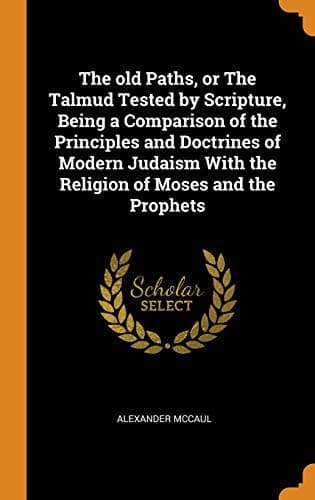
The old paths, or the Talmud tested by Scripture: Being a comparison of the principles and doctrines of modern Judaism with the religion of Moses and the prophetsMcCaul, Alexander
Religion
The old paths, or the Talmud tested by Scripture: Being a comparison of the principles and doctrines of modern Judaism with the religion of Moses and the prophets
McCaul, Alexander
Judaism -- Works to 1900
the inspired messengers of God. The Rabbies seem to have forgotten that
“the fear of the Lord is the beginning of wisdom,” and that this fear
may be implanted by God just as easily in the heart of a woman as of a
Rabbi. But without inquiring further into their reasons or their
motives, suffice it to say, that the oral law in thus robbing women of
their right and inheritance in the law of God, and in degrading them to
the same category with children and slaves, is opposed to the plain
commands of the written law. But not so the New Testament. It exactly
agrees with the Old in considering woman as a rational and responsible
being, and a candidate for everlasting life. It, therefore, gives one
general rule for the education of children, male and female. “Ye
fathers, provoke not your children to wrath, but bring them up in the
nurture and admonition of the Lord.” (Ephes. vi. 4.) It does indeed
prescribe modesty and subjection to the women in the mode or learning,
but in so doing it plainly points out their duty to become acquainted
with the will of God. “Let the woman learn in silence with all
subjection. But I suffer not a woman to teach nor to usurp authority
over the man, but to be in silence.” (1 Tim. ii. 11, 12.)
In these and other passages the woman is placed in the position assigned
her in the Old Testament, and not in the very subordinate rank imposed
upon her by the oral law. “Women, and slaves (עבדים), and children, are
exempt from the study of the law.” But we think that this rule is as
false with regard to slaves as to women. Here the oral law says that
slaves are not bound to learn. In Hilchoth Avadim, c. viii. 18, we find
that they are not to be taught.
אסור לאדם ללמד את עבדו תורה ׃
Public-domain text, read in full here on John Shaqi.
Reviews
Reviews
No reviews yet
Be the first to share your thoughts on this work.
Join the Discussion
Join the discussion
Sign in to leave a comment or review.
Sign InorCreate an account