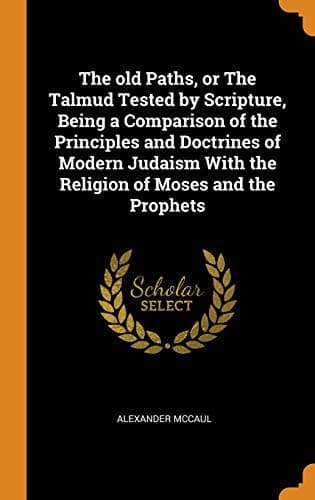
The old paths, or the Talmud tested by Scripture: Being a comparison of the principles and doctrines of modern Judaism with the religion of Moses and the prophetsMcCaul, Alexander
Religion
The old paths, or the Talmud tested by Scripture: Being a comparison of the principles and doctrines of modern Judaism with the religion of Moses and the prophets
McCaul, Alexander
Judaism -- Works to 1900
“But it shall come to pass, if thou wilt not hearken unto the voice of
the Lord thy God, to observe to do ALL his commandments and his statutes
which I command thee this day, that all these curses shall come upon
thee, and overtake thee. Cursed shalt thou be in the city, and cursed
shalt thou be in the field,” &c. (Deut. xxviii. 1-15.) Here Moses
plainly says, that he who is perfectly obedient is blessed, and that he
who is not perfectly obedient is cursed. And it is to be noted that
Moses knows nothing of an intermediate state of man, the בינוניים who
are neither righteous nor wicked. He divides all Israel into two
classes, the blessed and the cursed. He who keeps ALL God’s commandments
belongs to the former; he who does not keep ALL God’s commandments to
the latter. In this matter, than, the most important that can employ the
mind of man, the oral law contradicts the plain words of Moses. One of
the two is certainly in error. It is for the Israelites to choose
whether they will believe Moses, or that oral law which contradicts his
words. If they believe in Moses, then no one is accounted just before
God, but that man who has all the days of his life kept all God’s
commandments without one deviation. Every other person is so far from
being just, that he is accursed. If there were a human being who had all
his life kept all the commandments, and only once been guilty of
transgression, that one transgression makes him unjust and accursed. But
there is no such person. Every man’s conscience tells him that his sins
far exceed his obedience, and therefore if Moses speak truth he is
accursed. Oh, let no one endanger his salvation by trusting to the oral
law. Let him take up the law of Moses, let him investigate the
conditions which Moses lays down. We ask not now, that the Israelites
should read the New Testament, or that they should listen to our
arguments or any reasoning of man. We simply point out to them the words
of Moses, and we show other passages of the oral law which teaches an
entirely different doctrine. We ask, then, whether the man who rebels
against the law of Moses can hope for salvation? Yet this is what every
one who follows the oral law is doing. If his temporal welfare only were
concerned, it would not be of such moment. But here his eternal
interests are at stake. If the oral law be mistaken, and mistaken it is
if Moses spoke truth, their eternal salvation is forfeited by every one
who follows it. We therefore entreat every reader of this paper to take
up the law of Moses, and to investigate this question:—“What are the
conditions of blessing and cursing, of life and death, according to the
declarations of Moses? Does he promise life to that man whose merits
exceed his sins, or does he require universal obedience?” To Moses
himself we appeal, and him we constitute the arbiter of our differences.
No. XXXIII.
NEW YEAR, CONTINUED.
Public-domain text, read in full here on John Shaqi.
Reviews
Reviews
No reviews yet
Be the first to share your thoughts on this work.
Elsewhere in the archive
Join the Discussion
Join the discussion
Sign in to leave a comment or review.
Sign InorCreate an account