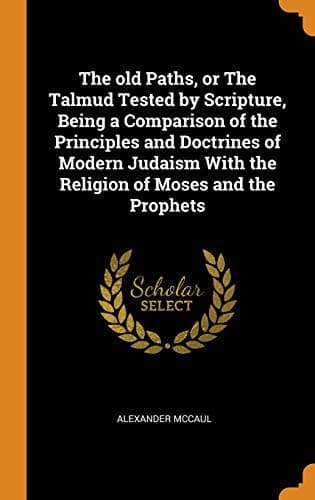
The old paths, or the Talmud tested by Scripture: Being a comparison of the principles and doctrines of modern Judaism with the religion of Moses and the prophetsMcCaul, Alexander
Religion
The old paths, or the Talmud tested by Scripture: Being a comparison of the principles and doctrines of modern Judaism with the religion of Moses and the prophets
McCaul, Alexander
Judaism -- Works to 1900
But the passage itself, which the oral law cites, proves nothing in
support of the above principle. The words were spoken of the son of
Jeroboam. “He only of Jeroboam shall come to the grave, because in him
there is found some good thing towards the Lord God of Israel in the
house of Jeroboam.” (1 Kings xiv. 13.) There is not one word said here
about his being justified by that one good thing, whatever it was. It
did not save the child from his sickness. It did not change the sentence
of death into life. All it did was to procure him a peaceable burial.
How, then, can any reasonable man argue, because the son of Jeroboam had
a peaceable burial, that therefore some meritorious act will save him
from the punishment due to his offences? To warrant such a conclusion,
he ought first to show that the son of Jeroboam had been a grievous
sinner like his father, which the Bible does not say; and, secondly,
that this one meritorious act had obtained pardon of his sins, and
restored him to life; and moreover it ought to be expressly said, that
God considered him as just. The very circumstance that the rabbies were
obliged to have recourse to such a passage, and that they could find
nothing better in the law or the prophets, shows that they were hard
pushed to find anything that would even bear a faint resemblance to
their doctrine.
The law of Moses gives no countenance to this doctrine, and can give
none, because it is directly subversive of all the principles of law and
justice. The stern principle of justice is, that every transgression of
the law should be followed by punishment without any reference whatever
to the good deeds or merits of the transgressor. Even before an earthly
tribunal, there is no deviation from this principle. If a murderer or a
robber be convicted, no degree of previous or subsequent merit can be
listened to as a plea against the just sentence of the law. He may in
all other respects be an unexceptionable character, he may feed the poor
and clothe the naked, and give all his goods in alms, but none of these
things can change the sentence of guilty into not guilty, or cause him
to be considered as a just or innocent person. And shall we suppose that
God is less just than man? The law of Moses gives us no reason for such
a supposition. It says distinctly—
ולא תקחו כופר לנפש רוצח אשר הוא רשע למות כי מות יומת ׃
Public-domain text, read in full here on John Shaqi.
Reviews
Reviews
No reviews yet
Be the first to share your thoughts on this work.
Elsewhere in the archive
Join the Discussion
Join the discussion
Sign in to leave a comment or review.
Sign InorCreate an account