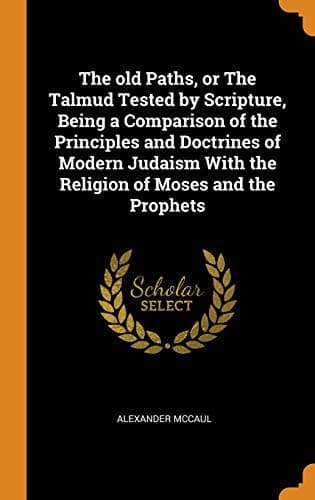
The old paths, or the Talmud tested by Scripture: Being a comparison of the principles and doctrines of modern Judaism with the religion of Moses and the prophetsMcCaul, Alexander
Religion
The old paths, or the Talmud tested by Scripture: Being a comparison of the principles and doctrines of modern Judaism with the religion of Moses and the prophets
McCaul, Alexander
Judaism -- Works to 1900
“Amongst all the commandments, there is not one that is equivalent to
the study of the law. Whereas the study of the law is equivalent to all
the commandments: for study leads to practice. Therefore, study always
goes before good deeds.” (Hilchoth Talmud Torah.) The one with his
money, therefore, and the other with his books, can effect a balance in
his favour; but what is to become of the poor labouring classes, who
have no money to buy righteousness, and no time for study, which is
equivalent to all the other commandments? For them to turn the balance
is impossible—they have not the means; and therefore, according to the
oral law, they stand but a poor chance when the final account comes to
be made up. This of itself would prove that the doctrine of the oral law
cannot be true. God is a righteous judge, and he accepts no man’s money
and no man’s learning. He takes no bribes, and will not wrest the
judgment of the poor. The true mode, therefore, of appearing just before
God, is some other than that pointed out by the oral law, and one
according to which the poor sinner will stand on equal terms with his
rich brother.
There is, however, another point to which we wish to direct attention.
The oral law says, if a man’s merits exceed his sins, he is just and
sealed unto life; but if his sins exceed his merits, then he is sealed
unto death: what then are we to think of all who die in each succeeding
year? It is plain that they have not been sealed unto life, for then
they could not have died. Then they were sealed unto death; then we must
conclude that their sins exceed their merits; and as all die, then we
must conclude, further, that all die in their sins—that their sins are
more than their merits; and so, after all, this rabbinical doctrine
comes to nothing. It tells a man that by having his merits greater than
his sins, he is righteous, and will be sealed unto life; and yet, after
all his almsgiving and good works, he dies like other men, and it turns
out that he is not a just man, nor even one of the intermediate class,
but one of the wicked. How can any rational man put his faith in such a
system, which promises a great deal, but does not keep its promise?
Above all, how can he trust his soul’s everlasting welfare upon a
promise which each successive year proves to be false? Many an one has
passed into eternity already before the New Year, and of all such the
oral law says they have died in their sins. Many more may pass into
eternity between the New Year and the Day of Atonement. If the oral law
be true, all such belong to the decidedly wicked who did not deserve the
ten days’ grace. Their friends and relations must, therefore, stamp
their memory with the brand of the impenitently wicked, or if they
entertain a hope that such persons have not died in their sins, they
must declare of the oral law that it is false. If they would have a
promise that will not and cannot deceive, let them take up the law and
the prophets.
Public-domain text, read in full here on John Shaqi.
Reviews
Reviews
No reviews yet
Be the first to share your thoughts on this work.
Elsewhere in the archive
Join the Discussion
Join the discussion
Sign in to leave a comment or review.
Sign InorCreate an account