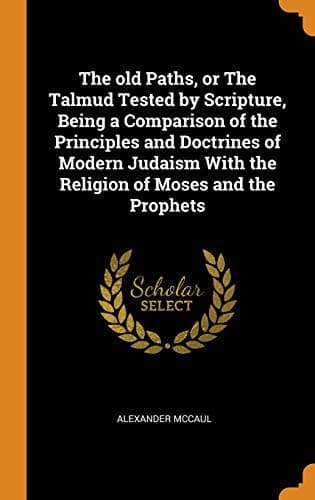
The old paths, or the Talmud tested by Scripture: Being a comparison of the principles and doctrines of modern Judaism with the religion of Moses and the prophetsMcCaul, Alexander
Religion
The old paths, or the Talmud tested by Scripture: Being a comparison of the principles and doctrines of modern Judaism with the religion of Moses and the prophets
McCaul, Alexander
Judaism -- Works to 1900
The Jewish deputies, when asked by Napoleon whether they considered
Frenchmen as their brethren, replied in the affirmative, and after
quoting the Mosaic laws respecting the stranger said, “To these
sentiments of benevolence towards the _stranger_, Moses has added the
precept of general love for mankind: ‘_Love thy fellow-creature as
thyself_.’”[7] And in the authorized Jewish Catechism used in Bavaria,
after the explanation of the moral duties, we find the following
question:—“Are these laws and duties, affirmative and negative
commandments, binding with respect to a non-Israelite?” ANSWER—“By all
means, for the fundamental law of all these duties, ‘_Love thy neighbour
as thyself_,’ is expressly laid down by the Holy Scriptures in reference
to the non-Israelite, yea, to the heathen, as it is written, ‘And if a
stranger sojourn with thee in your land, ye shall not vex him. But the
stranger that dwelleth with you shall be unto you as one born amongst
you, _and thou shalt love him as thyself_: for ye were strangers in the
land of Egypt: I am the Lord your God.’” (Levit. xix. 33-35.)[8] These
declarations are very explicit, and, as forming part of public
documents, highly satisfactory. The representatives of the Jewish people
in France, and the teachers of the Jewish youth in Bavaria, declare,
that in the scriptural command, “Thou shalt love thy neighbour as
thyself,” neighbour means _fellow-man_, without distinction of nation or
religion. Where then did they learn this interpretation? From the Talmud
or from the New-Testament? The Jewish deputies say, from the former. On
the page cited above they add, “This doctrine is also professed by the
Talmud. We are bound, says a Talmudist, to love as brethren all those
who observe the _Noachides_,[9] whatever their religious opinions may
otherwise be. We are bound to visit their sick, to bury their dead, to
assist their poor, like those of Israel. In short, there is no act of
humanity which a true Israelite is not bound to perform towards those
who observe the _Noachides_.” The Bavarian Catechism is more cautious.
It makes no such bold assertion respecting the Talmud. It only intimates
that the oral law teaches this doctrine, by subjoining to the passage
from Leviticus the same extract from Maimonides, alluded to by the
Jewish deputies. The Catechism gives the extract a little more at
length, and as follows:—“We are bound in everything to treat the
non-Israelite, who sojourns with us, with justice and with love, as we
would treat an Israelite. Yea, we are even bound to maintain him, as the
Scripture teaches in the words, ‘Thou shalt give it to the stranger that
is in thy gates, that he may eat it.’ (Deut. xiv. 21.) Our wise men have
commanded us for the good of society, even to visit the sick of the
heathen, to bury their dead, and to deal out alms to them: for of our
Creator it is said, ‘The Lord is good to all; and his tender mercies are
over all his works.’ (Psalm cxlv. 9.) (Maimonid.
Public-domain text, read in full here on John Shaqi.
Reviews
Reviews
No reviews yet
Be the first to share your thoughts on this work.
Join the Discussion
Join the discussion
Sign in to leave a comment or review.
Sign InorCreate an account