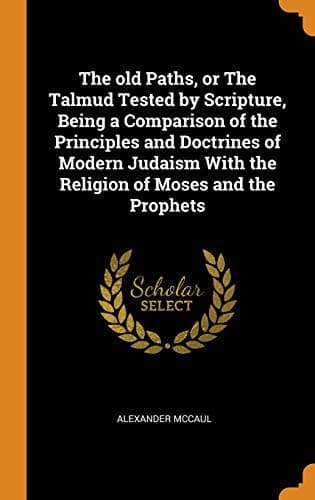
The old paths, or the Talmud tested by Scripture: Being a comparison of the principles and doctrines of modern Judaism with the religion of Moses and the prophetsMcCaul, Alexander
Religion
The old paths, or the Talmud tested by Scripture: Being a comparison of the principles and doctrines of modern Judaism with the religion of Moses and the prophets
McCaul, Alexander
Judaism -- Works to 1900
Hilchoth Melachim, 10,
12.)”
No doubt the passage as here given, both by the French deputies and the
Bavarian Catechism, is very plausible; and if it could be found
verbatim, either in the Talmud or any of its compendiums, would go far
to justify the bold assertion of the former, and the cautious
insinuation of the latter. But unfortunately the original passage is
very different. In the above citations, it is mutilated in order to suit
the purpose of the citers. In the Jad Hachasakah it stands as follows:—
וכן יראה לי שנוהגין עם גרי תושב בדרך ארץ וגמילות חסדים כישראל , שהרי אנו
מצווין להחיותן שנאמר לגר אשר בשעריך תתננה ואכלה , וזה שאמרו חכמים אין
כופלין להם שלום , בגוים לא בגר תושב , אפילו הגוים צוו חכמים לבקר חוליהם
, ולקבור מתיהם עם מתי ישראל , ולפרנס את ענייהם בכלל עניי ישראל , מפני
דרכי שלום , הרי נאמר טוב ה׳ לכל ורחמיו על כל מעשיו ונאמר דרכיה דרכי נועם
וכל נתיבותיה שלום ׃
“And thus it appears to me, that _the proselytes allowed to sojourn_ are
to be treated with the same courtesy and benevolence as the Israelites;
for behold, we are commanded to maintain them, as it is written, ‘Thou
shalt give it to the stranger (proselyte) that is in thy gates, that he
may eat it.’ _As to that saying of our wise men not to return their
salute, it refers to the Gentiles, not to the proselyte allowed to
sojourn._ But even with regard to the heathen, the wise men have
commanded us to visit their sick, and to bury their dead with the dead
of Israel, and to feed their poor along with the poor of Israel, FOR THE
SAKE OF THE WAYS OF PEACE: for it is written, ‘The Lord is good to all,
and his mercies are over all his works;’ and again, ‘Her ways are ways
of pleasantness, and all her paths are peace.’” (Prov. iii. 17.) The
reader will observe that there are several striking differences between
this translation and that of the Bavarian Catechism; and these
differences prove that, by the word “neighbour,” the oral law does not
understand a fellow-man without any regard to his religious opinions.
First, the Bavarian Catechism says, “We are bound in everything to treat
the non-Israelite who sojourns with us with justice and with love, and
as we would treat an Israelite.” The original says, “And thus _it
appears to me_, that _the proselytes allowed to sojourn_ are to be
treated with the same courtesy and benevolence as the Israelites.” The
Bavarian Catechism translates this passage as it if were the undisputed
law of Israel thus to act; whereas Maimonides only offers his own
opinion. He says, “It appears to me.” Here the French deputies represent
the matter more accurately, by saying, “We are bound, says _a
Talmudist_.” Not the Talmud, but a Talmudist. Then, again, the Bavarian
Catechism speaks generally of “non-Israelites.” Maimonides speaks of
only one particular class, the proselytes who had permission to sojourn
in the land of Israel. That we do not misrepresent Maimonides’ meaning,
is plain from the words of the Jewish deputies, who also restrict the
Public-domain text, read in full here on John Shaqi.
Reviews
Reviews
No reviews yet
Be the first to share your thoughts on this work.
Join the Discussion
Join the discussion
Sign in to leave a comment or review.
Sign InorCreate an account