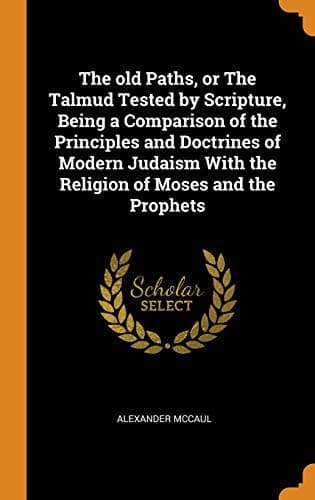
The old paths, or the Talmud tested by Scripture: Being a comparison of the principles and doctrines of modern Judaism with the religion of Moses and the prophets — John Shaqi
The old paths, or the Talmud tested by Scripture: Being a comparison of the principles and doctrines of modern Judaism with the religion of Moses and the prophetsMcCaul, Alexander
Religion
The old paths, or the Talmud tested by Scripture: Being a comparison of the principles and doctrines of modern Judaism with the religion of Moses and the prophets
McCaul, Alexander
Judaism -- Works to 1900
It would, therefore, have been doubly his duty to conceal from
the idolaters the means of deliverance. On this supposition, Jonah’s
counsel to them can only be accounted for on the principle that he was
not a Talmudist, but considered it his duty to save the lives of
perishing idolaters, even when nothing was to be feared or to be gained.
If, on the other hand, he did not know of the fish, he must have
expected a watery grave, whether the idolaters threw him into the sea,
or whether he waited until the ship went to pieces. In this case, also,
if a Talmudist, it would have been his duly to have staged where he was,
and if he perished, die in the fulfilment or the command, to show no
mercy to idolaters. But he did not—he had compassion on them, and, to
save their lives, relinquished his only chance of safety, by telling
them to throw him into the sea. It is plain, therefore, Jonah was not a
Talmudist. We have here, then, three inspired prophets, Daniel, Elisha,
and Jonah, all bearing a practical testimony against the Talmudic
principle, which extends God’s law against the Canaanites to all
idolaters, and under all circumstances.
Lastly, We have the testimony of the God of Israel himself. He who gave
the command to destroy the Canaanites on account of their exceeding
wickedness, shows by his own dealings with the world, that this case is
an exception to the general rule, for “The Lord is good to all, and his
mercies are over all his works.” He provides food and clothing for the
idolater, as well as for those who worship him in truth; or, as the New
Testament says, “He maketh his sun to rise on the evil and on the good,
and sendeth rain on the just and the unjust.” (Matt. vi. 45.) He, then,
whose conduct most resembles that of his Creator, is, beyond all doubt,
the nearest to the truth. The Talmud, therefore, is wrong, and the New
Testament explanation of the command, “Thou shalt love thy neighbour as
thyself,” is right. We ask the Jews, then, to account for this fact,
that Jesus of Nazareth was right, and those who condemned him wrong,
respecting one-half of the whole law. And we ask, moreover, those Jews
who abhor the above Talmudic principles, how they can conscientiously
join in the synagogue prayers, which ascribe to the Talmud Divine
authority? We ask them why, at the very least, they have never publicly
protested against these enormities; but allow their brethren through the
world to remain victims to a system, which not only contradicts the
written law of God, but outrages all the better feelings of even fallen
humanity?
Footnote 11:
Hilchoth Rotzeach, c. xii. 15. See also Bava Bathra, fol. iv. col. 1.,
about the middle of the page, where the punishment of Daniel is more
fully discussed.
No. VI.
COMPULSORY CONVERSION OF THE GENTILES.
Public-domain text, read in full here on John Shaqi.
Reviews
Reviews
No reviews yet
Be the first to share your thoughts on this work.
Join the Discussion
Join the discussion
Sign in to leave a comment or review.
Sign InorCreate an account