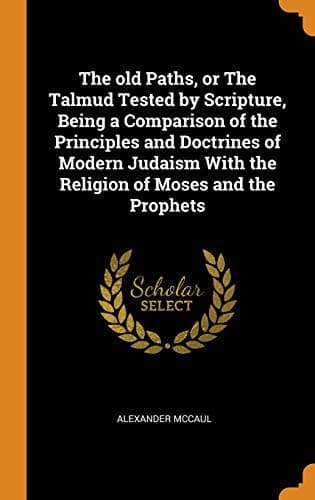
The old paths, or the Talmud tested by Scripture: Being a comparison of the principles and doctrines of modern Judaism with the religion of Moses and the prophetsMcCaul, Alexander
Religion
The old paths, or the Talmud tested by Scripture: Being a comparison of the principles and doctrines of modern Judaism with the religion of Moses and the prophets
McCaul, Alexander
Judaism -- Works to 1900
“And thus Moses our master, has commanded us, by Divine tradition, to
compel all that come into the world to take upon themselves the
commandments imposed upon the sons of Noah, and whosoever will not
receive them is to be put to death.” (Hilchoth Melachim, c. viii. 4.)
Such is the Talmudic system of toleration, and such the means which it
prescribes for the conversion of the world. We acknowledge that persons
calling themselves Christians have had an oral law very similar in its
principles and precepts, but we fearlessly challenge the whole world to
point out anything similar in the doctrines of Jesus Christ, or in the
writings of his apostles. The New Testament does, indeed, teach us to
seek the conversion of the world, not by force of arms, but by teaching
the truth. “Go ye, therefore, and make disciples of all nations,
baptizing them in the name of the Father, and of the Son, and of the
Holy Ghost; teaching them to observe all things whatsoever I have
commanded you.” (Matt. xxviii. 19.) In the parable of the tares and
wheat, Jesus of Nazareth hath expressly taught us that physical force is
not to be employed in order to remove moral error. The servants are
represented as asking the master of the house, whether they should go
and root out the tares that grew amongst the wheat, but the answer is,
“Nay, lest while ye gather up the tares, ye root up also the wheat with
them. Let both grow together until the harvest; and in the time of
harvest I will say to the reapers, Gather ye together first the tares,
and bind them in bundles to burn them: but gather the wheat into my
barn.” (Matt. xiii. 24-43.) He tells us expressly to have nothing to do
with the sword, “For all they that take the sword, shall perish with the
sword.” (Matt. xxvi. 52.) And therefore the apostle says, “The weapons
of our warfare are not carnal, but mighty through God to the pulling
down of strong holds.” (2 Cor. x. 4.) Here again, then, there is a great
difference between the oral law and the New Testament. The former
commands that the truth be maintained and propagated by the sword. The
latter tells us that “faith cometh by hearing, and hearing by the Word
of God.” Which, then, is most agreeable to the doctrine of Moses and the
prophets? We answer fearlessly, the means prescribed by the New
Testament, for—
Public-domain text, read in full here on John Shaqi.
Reviews
Reviews
No reviews yet
Be the first to share your thoughts on this work.
Join the Discussion
Join the discussion
Sign in to leave a comment or review.
Sign InorCreate an account