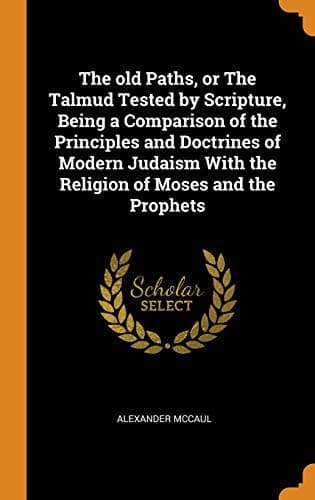
The old paths, or the Talmud tested by Scripture: Being a comparison of the principles and doctrines of modern Judaism with the religion of Moses and the prophetsMcCaul, Alexander
Religion
The old paths, or the Talmud tested by Scripture: Being a comparison of the principles and doctrines of modern Judaism with the religion of Moses and the prophets
McCaul, Alexander
Judaism -- Works to 1900
The feast of Purim now at hand, recalls to the Jewish recollection one
of those miraculous deliverances, with which the history of Israel
abounds. The narrative of the institution, as contained in the Bible, is
a signal proof and illustration of the superintending providence of God,
instructive to all the world, but calling peculiarly for the gratitude
and praise of the Jewish nation, whose forefathers were then delivered.
And it is much to the honour of their posterity that they have not
suffered the lapse of more than twenty centuries to wear out the memory
of this great event, but that to this day they observe its anniversary
with alacrity and zeal. If the oral law simply contented itself with
commanding the observance and prescribing the mode of worship for such
an important season, we should have no fault to find; but the oral law
claims for itself Divine origin and authority, anathematizes any denial
of these claims as heresy, and sentences the heretic to death. We are,
therefore, compelled to examine its pretensions, and to scrutinize its
features, in order to see whether they really bear the stamp of
divinity. We have already pointed out some, that savoured more of earth
than heaven: the constitutions for the feast of Purim may be traced to
the same source. The following law respecting the meal to be provided on
this occasion did certainly not come to man from heaven:—
חובת סעודה זו שיאכל בשר ויתקן סעודה נאה כפי אשר תמצא ידו , ושותה יין עד
שישתכר וירדם בשכרותו ׃
“A man’s duty with regard to the feast is, that he should eat meat and
prepare a suitable feast according to his means; and drink wine, until
he be drunk, and fell asleep in his drunkenness.” (Hilchoth Megillah, c.
ii. 15.) The Talmud, however, is not satisfied with so indefinite a
direction, but lays down, with its usual precision, the exact measure of
intoxication required.
חייב איניש לבסומי בפוריא עד דלא ידע בין ארור המן לברוך מרדכי ׃
Public-domain text, read in full here on John Shaqi.
Reviews
Reviews
No reviews yet
Be the first to share your thoughts on this work.
Join the Discussion
Join the discussion
Sign in to leave a comment or review.
Sign InorCreate an account