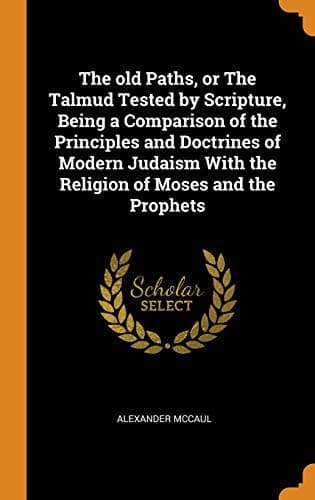
The old paths, or the Talmud tested by Scripture: Being a comparison of the principles and doctrines of modern Judaism with the religion of Moses and the prophetsMcCaul, Alexander
Religion
The old paths, or the Talmud tested by Scripture: Being a comparison of the principles and doctrines of modern Judaism with the religion of Moses and the prophets
McCaul, Alexander
Judaism -- Works to 1900
“A man is bound to get so drunk with wine at Purim, as not to know the
difference between Cursed is Haman, and Blessed is Mordecai.” (Megillah,
fol. 7, col. 2.) But perhaps some learned champion of the Talmud will
fly to that sort of refuge for destitute commentators, the parabolic
language of the orient, and tell us that this precept is not to be
understood literally but figuratively; and that so far from recommending
intoxication, it means to inculcate excess of sobriety or devotion, such
abstraction of the senses, from all outward objects, as not to
distinguish between cursed is Haman and blessed is Mordecai. This sort
of defence is neither imaginary nor novel. In this way Rabbi Eliezer’s
permission to split open an unlearned man like a fish has been made to
signify the spiritual opening of the understanding, and of course the
overweening anxiety of the Rabbies to communicate instruction to the
ignorant. But however we dull Gentiles may be enlightened by such an
exposition, we much doubt whether the greatest amhaaretz in Israel will
believe the interpretation. The great and learned Rabbies Solomon Jarchi
and Moses Maimonides have understood literal drunkenness, and have named
wine as the legitimate liquor. R. Joseph Karo has simply given the
command verbatim as it stands in the Talmud, but a note in the Orach
Chaiim shows, that some of the modern Rabbies were not able to swallow
such a command, and, therefore, say that an Israelite does his duty, if
he only drink a little more than usual. The Talmud itself admits of no
such softening down, nor explaining away, for immediately after the
precept it goes on to propose an example and to furnish an illustration
of its meaning in the following history of the very Rabbi, on whose
authority this traditional command rests;—
רבה ורבי זירא עבדו סעודת פורים בהדי הדדי , איבסום קם רבה שחטיה לרבי זירא
למחר בעא רחמי ואחייה , לשנה אמר ליה ניתי מר ונעביד סעודת פורים בהדי הדדי
אמר ליה לאו בכל שעתא ושעתא מתרחיש ניסא ׃
Public-domain text, read in full here on John Shaqi.
Reviews
Reviews
No reviews yet
Be the first to share your thoughts on this work.
Join the Discussion
Join the discussion
Sign in to leave a comment or review.
Sign InorCreate an account