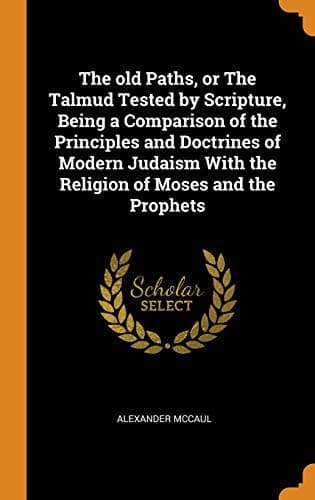
The old paths, or the Talmud tested by Scripture: Being a comparison of the principles and doctrines of modern Judaism with the religion of Moses and the prophets — John Shaqi
The old paths, or the Talmud tested by Scripture: Being a comparison of the principles and doctrines of modern Judaism with the religion of Moses and the prophetsMcCaul, Alexander
Religion
The old paths, or the Talmud tested by Scripture: Being a comparison of the principles and doctrines of modern Judaism with the religion of Moses and the prophets
McCaul, Alexander
Judaism -- Works to 1900
“Rabbi Ishmael says,” &c. At the end of the daily prayers we find a
whole treatise of the oral law, called, פרקי אבות, “the ethics of the
fathers,” the beginning of which treatise asserts the transmission of
the oral law. In the morning service for Pentecost, there is a most
comprehensive declaration of the authority and constituent parts of the
oral law. “He, the Omnipotent, whose reverence is purity, with his
mighty word he instructed his chosen, and clearly explained the law,
with the word, speech, commandment, and admonition, in the Talmud, the
Agadah, the Mishna, and the Testament, with the statutes, the
commandment, and the complete covenant,” &c., p. 89. In this prayer, as
used, translated, and published by the Jews themselves, the divine
authority of the oral law is explicitly asserted, and the Talmud,
Agadah, and Mishna, are pointed out as the sources where it is to be
found. For these two reasons, then, we conclude that the Judaism of the
Jewish Prayer-book is identical with the Judaism of the oral law, and
that every Jew who publicly joins in those prayers does, with his lips
at least, confess its divine authority.
Having explained what we mean by Judaism, we now go on to another
preliminary topic. Some one may ask, what is the use of discussing these
two systems? May they not both be safe ways of salvation for those that
profess them? To this we must, according to the plain declarations of
these systems themselves, reply in the negative. The New Testament
denounces the oral law as subversive of the law of God. “Then the
Pharisees and scribes asked him, Why walk not thy disciples according to
the tradition of the elders, but eat bread with unwashen hands? He
answered and said unto them, Well hath Esaias prophesied of you
hypocrites, as it is written, This people honoureth me with their lips,
but their heart is far from me. Howbeit in vain do they worship me,
teaching for commandments the doctrines of men.” (Mark vii. 5-7.) The
oral law is still more exclusive. It excludes from everlasting life all
who deny its authority, and explicitly informs us that Christians are
comprehended in anathema,—
ואלו הן שאין להם הלק לעולם הבא אלא נכרתין ואובדין ונדונין על גודל רשעם
וחטאתם לעולם ולעולמי עולמים המינין והאפיקורסין והכופרים בתורה וכו ׃
“_These are they who have no part in the world to come, but who are cut
off, and perish, and are condemned on account of the greatness of their
wickedness and sin for ever, even for ever and ever, the heretics and
the Epicureans, and the deniers of the law_,” &c. Here is the general
statement. But to prevent all mistake, a particular definition of each
of these classes is added, from which we extract the following passage:—
Public-domain text, read in full here on John Shaqi.
Reviews
Reviews
No reviews yet
Be the first to share your thoughts on this work.
Join the Discussion
Join the discussion
Sign in to leave a comment or review.
Sign InorCreate an account