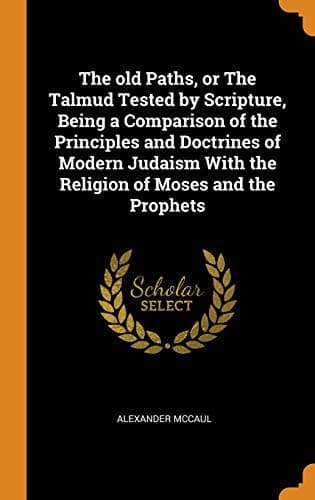
The old paths, or the Talmud tested by Scripture: Being a comparison of the principles and doctrines of modern Judaism with the religion of Moses and the prophetsMcCaul, Alexander
Religion
The old paths, or the Talmud tested by Scripture: Being a comparison of the principles and doctrines of modern Judaism with the religion of Moses and the prophets
McCaul, Alexander
Judaism -- Works to 1900
“Before the giving of the law, a man might happen to meet a woman in the
street; if they both agreed on marriage, he took her to his house, and
cohabited with her, and she became his wife.” (Hilchoth Ishuth, c. i.
1.) Now, not to speak of profane history, there is not in the law of
Moses a single passage to give colour to this statement, unless it be
the following:—“And it came to pass, when men began to multiply on the
face of the earth, and daughters were born unto them, that the sons of
God saw the daughters of men that they were fair; and they took them
wives of all which they chose.” But, whatever is meant by “Sons of God,”
it is plain that this conduct is mentioned, not as having the sanction
or approval of God, but as a proof of antediluvian wickedness, for it is
immediately added, “And the Lord said, My Spirit shall not always strive
with man, for that he also is flesh.” But it is not simply an error of
judgment, it is most pernicious as it regards both Gentiles and Jews,
for it completely annuls the sanctity and obligation of the marriage
tie. It teaches that as the marriage of Noahites is contracted without
solemn espousals, so it may be dissolved without the formality of a
divorce.
ומאימתי תהיה אשת חברו כגרושה שלנו ? משיוציאנה מביתו וישלחנה לעצמה , או
שתצא היא מתחת רשותו ותלך לה , שאין להן גירושין בכתב , ואין הדבר תלוי בו
לבד , אלא כל זמן שירצה הוא או היא לפרוש זה מזה פורשין ׃
“When is his (the Noahite’s) neighbour’s wife to be considered in the
same light, as a divorced woman with us?
From the time that he sends her forth from his house, and leaves her to
herself. Or from the time that she goes forth from under his power, and
goes her way; for they have no divorces in writing, neither does the
matter depend upon that alone;[15] but whenever he or she please to
separate one from the other, they separate.” (Hilchoth Melachim, c. ix.
8.) We Gentiles have great reason to be thankful that Jesus of Nazareth
has taught us a different doctrine, according with the original
institution of marriage. What would have been the state of the world, if
the oral law had attained supreme power, and the Gentiles had been
instructed in the above law as Divine? What would result from the
doctrine that every man may turn out his wife, and every woman leave her
husband, whenever they like? The peace and well-being of Gentile society
would be at an end. The frightful state of disorder and misery that
would ensue, as well as the words of the original institution, plainly
show that this doctrine is not from God. But the effect upon the
believers in the oral law is still worse. With reference to them, the
marriage of Gentiles is no marriage at all. The oral law says
distinctly—
אין אישות לגוים .
“There is no matrimony to the Gentiles.” (Hilchoth Melachim, viii. 3.)
And again,
אין אישות אלא לישראל או לגוים על הגוים אבל לא לעבדים על עבדים ולא לעבדים
על ישראל ׃
Public-domain text, read in full here on John Shaqi.
Reviews
Reviews
No reviews yet
Be the first to share your thoughts on this work.
Join the Discussion
Join the discussion
Sign in to leave a comment or review.
Sign InorCreate an account