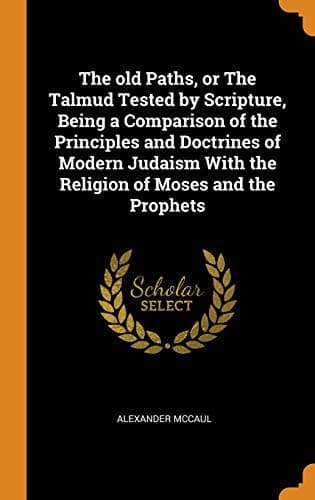
The old paths, or the Talmud tested by Scripture: Being a comparison of the principles and doctrines of modern Judaism with the religion of Moses and the prophets — John Shaqi
The old paths, or the Talmud tested by Scripture: Being a comparison of the principles and doctrines of modern Judaism with the religion of Moses and the prophetsMcCaul, Alexander
Religion
The old paths, or the Talmud tested by Scripture: Being a comparison of the principles and doctrines of modern Judaism with the religion of Moses and the prophets
McCaul, Alexander
Judaism -- Works to 1900
“There is no matrimony except to Israel, or to Gentiles with respect to
Gentiles; but not to slaves with respect to slaves, nor to slaves with
respect to Israel.” (Hilchoth Issure Biah, c. xiv. 19.) Here, then, the
oral law directly makes void the law of God, and pronounces that a
command given to Adam in Paradise, and therefore equally binding on all
his descendants, is in particular cases of no force at all. The oral
law, therefore, is certainly not from God.
We have already made out nine commandments; in sacrifice we find a
tenth. Cain and Abel brought sacrifices, and the only reason that can be
assigned is, that they had received a command to that effect. Sacrifice
was either a Divine command or the dictate of their own reason. But it
was not the dictate of reason, for reason says, that the Creator of all
things has no need of gifts, and, least of all, such gifts as imply the
slaughter of an innocent animal. It must, therefore, have been of Divine
command. The reason why the Rabbies excluded this command is plain. They
did not choose that there should be acceptable sacrifices offered
anywhere but amongst themselves. But that this doctrine is altogether of
a recent date is plain. It was not known to Job. He says not a word
about the seven commandments, and he was in the habit of offering
sacrifices. “And it was so when the day of their feasting was gone
about, that Job sent and sanctified them, and rose up early in the
morning, and offered burnt-offerings according to the number of them
all.” (Job i. 5.) And the Lord himself expressly commanded Job’s friends
to do so likewise. “And it was so, that after the Lord had spoken these
words unto Job, the Lord said to Eliphaz the Temanite, My wrath is
kindled against thee, and against thy two friends.... Therefore, take
unto you now seven bullocks and seven rams, and go to my servant Job,
and offer up for yourselves a burnt-offering, and my servant Job shall
pray for you, for him will I accept.” (Job xlii. 7, 8.) It was not known
to Elisha. When Naaman said, “Shall there not then, I pray thee, be
given to thy servant two mules’ burden of earth? For thy servant will
henceforth offer neither burnt-offering nor sacrifice unto other gods,
but unto the Lord.” (2 Kings v. 17.) Elisha made no objection. He did
not tell him that he had only seven commandments to attend to. Neither
had Isaiah any idea that, when Judaism triumphed, the whole world was to
be compelled to adhere to the seven commandments, for he plainly
predicts the contrary. “And the Lord shall be known to Egypt, and the
Egyptians shall know the Lord in that day, and shall do sacrifice and
oblation: yea, they shall vow a vow unto the Lord and perform it.”
(Isaiah xix. 21.) Here again, then, the oral law contradicts the Word of
God.
Public-domain text, read in full here on John Shaqi.
Reviews
Reviews
No reviews yet
Be the first to share your thoughts on this work.
Join the Discussion
Join the discussion
Sign in to leave a comment or review.
Sign InorCreate an account