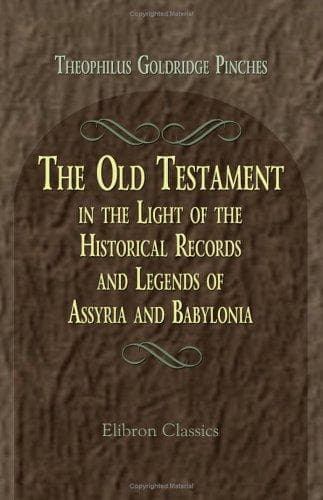
The Old Testament in the Light of the Historical Records and Legends of Assyria and BabyloniaPinches, Theophilus G. (Theophilus Goldridge)
Religion
The Old Testament in the Light of the Historical Records and Legends of Assyria and Babylonia
Pinches, Theophilus G. (Theophilus Goldridge)
Bible. Old Testament -- Criticism, interpretation, etc.
There is no doubt, that in the story of Joseph there exists a considerable
amount of what is known as “local colour.” This is shown by the freedom
which the women of Egypt evidently enjoyed (as exhibited in the story of
Potiphar’s wife), the matter of Joseph shaving himself before going to see
Pharaoh, the many undoubtedly Egyptian names, etc. These, of course, are
undeniable points in favour of the authenticity of the narrative, which,
perfect as it is, omits one important thing, namely, the name of the
Pharaoh who ruled at the time. That there should be such an omission in
the comparatively unimportant references to the visits of Abraham and
Isaac to Egypt is, perhaps, not so very strange, but that there should be
no clue to the identity of the Egyptian ruler under whom Joseph entered
Egypt, nor to the persecutor of the Israelites under whose reign they went
forth from what had become to them practically a hostile land, is
noteworthy, and a matter for great regret. It is, therefore, not to be
wondered at that scholars have arisen who doubt the whole story, for the
least flaw in a narrative in the present day, when unbelief and the desire
for scientific proof meet one on every hand, will cause a thinking man to
doubt anything and everything.
The degree of civilization to which Egypt had attained at this period, and
probably thousands of years earlier, is so remarkable that it is difficult
for us at this distance of time to realize it. Whether the country was in
reality more civilized than Babylonia is a matter of doubt—possibly we
regard their civilization as superior on account of the monuments being so
much better preserved, and because, in consequence of the nature of the
climate (which is such as to preserve even perishable things), an untold
wealth of material exists. This was not the case with Babylonia, in which
country the annual rains have caused almost all woodwork to decay, and
only objects of stone and clay, and much more rarely metal, remain, even
these being in many instances more or less damaged and therefore defective
as really useful historical documents.
Public-domain text, read in full here on John Shaqi.
Reviews
Reviews
No reviews yet
Be the first to share your thoughts on this work.
Elsewhere in the archive
Join the Discussion
Join the discussion
Sign in to leave a comment or review.
Sign InorCreate an account