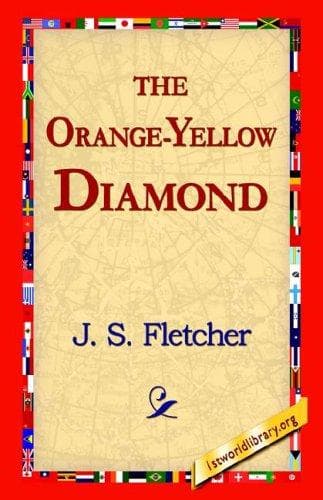
The Orange-Yellow DiamondFletcher, J. S. (Joseph Smith)
General
The Orange-Yellow Diamond
Fletcher, J. S. (Joseph Smith)
Detective and mystery stories; Diamonds -- Fiction; London (England) -- Fiction
Lauriston, walking back to his room after leaving Melky at the door of
the eating-house, faced the situation in which an unfortunate
combination of circumstances had placed him. Ayscough had been placable
enough; the authorities at the police-station had heard his own version
of things with attention--but he was still conscious that he was under
a certain amount of suspicion. More than that, he felt convinced that
the police would keep an eye on him that night. Ayscough, indeed, had
more than hinted that that would probably be done. For anything he
knew, some plain-clothes man might be shadowing him even then--anyway,
there had been no mistaking the almost peremptory request of the
inspector that he should report himself at the police station in the
morning. It was no use denying the fact--he was suspected, in some
degree.
He knew where the grounds of suspicion lay--in his possession of two
rings, which were undoubtedly very similar to the rings which lay in
the tray that he and the detective had found on the table in the
back-parlour of the pawnshop. It needed no effort on the part of one
who had already had considerable experience in the construction of
plots for stories, to see how the police would build up a theory of
their own. Here, they would say, is a young fellow, who on his own
confession, is so hard up, so penniless, indeed, that he has had to
pawn his watch. He has got to know something of this particular
pawnshop, and of its keepers--he watches the girl leave; he ascertains
that the old man is alone; he enters, probably he sees that tray of
rings lying about; he grabs a couple of the rings; the old man
interrupts him in the act; he seizes the old man, to silence his
outcries; the old man, feeble enough at any time, dies under the shock.
A clear, an unmistakable case!
What was he, Lauriston, to urge against the acceptance of such a
theory? He thought over everything that could be said on his behalf.
The friendliness of Zillah and her cousin Melky towards him could be
dismissed--that, when it came to it, would weigh little against the
cold marshalling of facts which a keen legal mind would put into the
opposite scale. His own contention that it was scarcely probable that
he should have gone to the pawnshop except to pledge something, and
that that something was the rings, would also be swept aside, easily
enough: his real object, the other side would say, had been robbery
when the old man was alone: what evidence had he that the two rings
which he had in his hand when Ayscough found him hurrying out of the
shop were really his?
Public-domain text, read in full here on John Shaqi.
Reviews
Reviews
No reviews yet
Be the first to share your thoughts on this work.
Join the Discussion
Join the discussion
Sign in to leave a comment or review.
Sign InorCreate an account