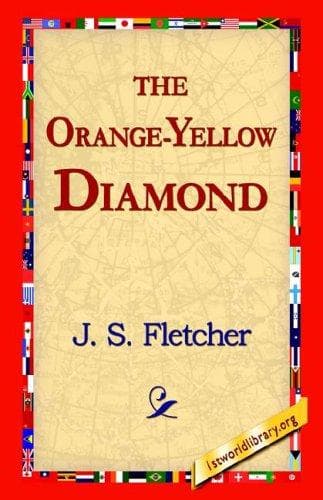
The Orange-Yellow DiamondFletcher, J. S. (Joseph Smith)
General
The Orange-Yellow Diamond
Fletcher, J. S. (Joseph Smith)
Detective and mystery stories; Diamonds -- Fiction; London (England) -- Fiction
Here, Lauriston knew he was in a difficulty. He had kept these two
rings safely hidden in his old-fashioned trunk ever since coming to
London, and had never shown them to a single person--he had, indeed,
never seen them himself for a long time until he took them out that
afternoon. But where was his proof of that! He had no relations to whom
he could appeal. His mother had possessed an annuity; just sufficient
to maintain her and her son, and to give Lauriston a good education: it
had died with her, and all that she had left him, to start life on, was
about two hundred pounds and some small personal belongings, of which
the rings and his father's watch and chain were a part. And he
remembered now that his mother had kept those rings as securely put
away as he had kept them since her death--until they came into his
hands at her death he had only once seen them; she had shown them to
him when he was a boy and had said they were very valuable. Was it
possible that there was any one, far away in Scotland, who had known
his mother and who would come forward--if need arose--and prove that
those rings had been her property? But when he had put this question to
himself, he had to answer it with a direct negative--he knew of no one.
There was one gleam of hope in this critical situation. John Purdie was
coming to London. Lauriston had always felt that he could rely on John
Purdie, and he had just received proof of the value of his faith in his
old schoolmate. John Purdie would tell him what to do: he might even
suggest the names of some of Mrs. Lauriston's old friends. And perhaps
the need might not arise--there must surely be some clue to the old
pawnbroker's assailant; surely the police would go deeper into the
matter. He cheered up at these thoughts, and having written replies to
the two welcome letters and asked John Purdie to see him immediately on
his arrival in town, he went out again to the post-office and to fulfil
his promise to Melky to call at the pawnshop.
Lauriston was naturally of quick observation. He noticed now, as he
stepped out into the ill-lighted, gloomy street that a man was pacing
up and down in front of the house. This man took no notice of him as he
passed, but before he had reached Praed Street, he glanced around, and
saw that he was following him. He followed him to Spring Street
post-office; he was in his rear when Lauriston reached the pawnshop.
Idly and perfunctorily as the man seemed to be strolling about,
Lauriston was sure that he was shadowing him--and he told Melky of the
fact when Melky admitted him to the shop by the private door.
Public-domain text, read in full here on John Shaqi.
Reviews
Reviews
No reviews yet
Be the first to share your thoughts on this work.
Join the Discussion
Join the discussion
Sign in to leave a comment or review.
Sign InorCreate an account