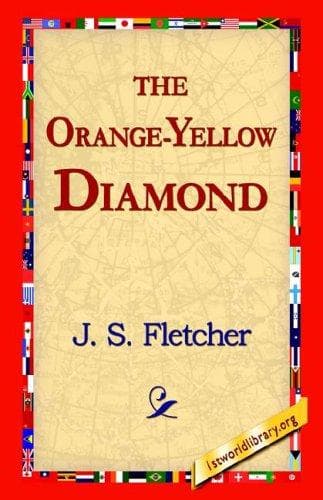
The Orange-Yellow DiamondFletcher, J. S. (Joseph Smith)
General
The Orange-Yellow Diamond
Fletcher, J. S. (Joseph Smith)
Detective and mystery stories; Diamonds -- Fiction; London (England) -- Fiction
The story of the circumstances of Daniel Multenius's death, as unfolded
in the witness-box into which one person went after another, appeared
to be the fairly plain one--looked at from one point of view: there was
a certain fascination in its unfolding. It began with Melky, who was
first called--to identify the deceased, to answer a few general
questions about him, and to state that when he last saw him, a few
hours before his death, he was in his usual good health: as good, at
any rate, as a man of his years--seventy-five--who was certainly
growing feeble, could expect to be in. Nothing much was asked of Melky,
and nothing beyond bare facts volunteered by him: the astute Mr.
Parminter left him alone. A more important witness was the
police-surgeon, who testified that the deceased had been dead twenty
minutes when he was called to him, that he had without doubt been
violently assaulted, having been savagely seized by the throat and by
the left arm, on both of which significant marks were plainly visible,
and that the cause of death was shock following immediately on this
undoubted violence. It was evident, said this witness, that the old man
was feeble, and that he suffered from a weak heart: such an attack as
that which he had described would be sufficient to cause death, almost
instantly.
"So it is a case of murder!" muttered Melky, who had gone back to sit
by Lauriston. "That's what the police is leading up to. Be careful,
mister!"
But there were three witnesses to call before Lauriston was called
upon. It was becoming a mystery to him that his evidence was kept back
so long--he had been the first person to find the old man's dead body,
and it seemed, to his thinking, that he ought to have been called at a
very early stage of the proceedings. He was about to whisper his
convictions on this point to Melky, when a door was opened and Zillah
was escorted in by Ayscough, and led to the witness-box.
Zillah had already assumed the garments of mourning for her
grandfather. She was obviously distressed at being called to give
evidence, and the Coroner made her task as brief as possible. It
was--at that stage--little that he wanted to know. And Zillah told
little. She had gone out to do some shopping, at half-past-four on the
previous afternoon. She left her grandfather alone. He was then quite
well. He was in the front shop, doing nothing in particular. She was
away about an hour, when she returned to find Detective-Sergeant
Ayscough, whom she knew, and Mr. Lauriston, whom she also knew, in the
shop, and her grandfather dead in the parlour behind. At this stage of
her evidence, the Coroner remarked that he did not wish to ask Zillah
any further questions just then, but he asked her to remain in court.
Mrs. Goldmark had followed her, and she and Zillah sat down near Melky
and Lauriston--and Lauriston half believed that his own turn would now
come.
Public-domain text, read in full here on John Shaqi.
Reviews
Reviews
No reviews yet
Be the first to share your thoughts on this work.
Join the Discussion
Join the discussion
Sign in to leave a comment or review.
Sign InorCreate an account