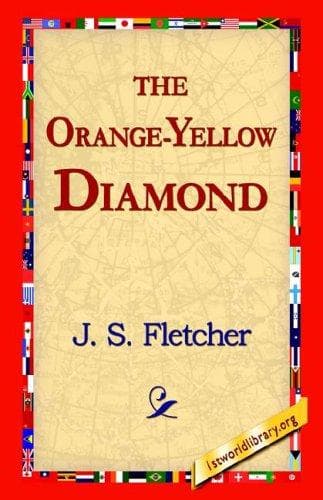
The Orange-Yellow DiamondFletcher, J. S. (Joseph Smith)
General
The Orange-Yellow Diamond
Fletcher, J. S. (Joseph Smith)
Detective and mystery stories; Diamonds -- Fiction; London (England) -- Fiction
But Ayscough was next called--to give a brief, bald, matter-of-fact
statement of what he knew. He had gone to see Mr. Multenius on a
business affair--he was making enquiries about a stolen article which
was believed to have been pledged in the Edgware Road district. He told
how Lauriston ran into him as he entered the shop; what Lauriston said
to him; what he himself saw and observed; what happened afterwards. It
was a plain and practical account, with no indication of surprise,
bias, or theory--and nobody asked the detective any questions arising
out of it.
"Ain't nobody but you to call, now, mister," whispered Melky. "Mind
your p's and q's about them blooming rings--and watch that Parminter!"
But Melky was mistaken--the official eye did not turn upon Lauriston
but, upon the public benches of the court, as if it were seeking some
person there.
"There is a witness who has volunteered a statement to the police,"
said the Coroner. "I understand it is highly important. We had better
hear him at this point. Benjamin Hollinshaw!"
Melky uttered a curious groan, and glanced at Lauriston.
"Fellow what has a shop right opposite!" he whispered. "S'elp
me!--what's he got to say about it?"
Benjamin Hollinshaw came forward. He was a rather young, rather
self-confident, self-important sort of person, who strode up to the
witness-box as if he had been doing things of importance and moment all
his life, and was taking it quite as a matter of course that he should
do another. He took the oath and faced the court with something of an
air, as much as to imply that upon what he was about to say more
depended than any one could conceive. Invited to tell what he knew, he
told his story, obviously enjoying the telling of it. He was a
tradesman in Praed Street: a dealer in second-hand clothing, to be
exact; been there many years, in succession to his father. He
remembered yesterday afternoon, of course. About half-past-five o'clock
he was standing at the door of his shop. It was directly facing Daniel
Multenius's shop door. The darkness had already come on, and there was
also a bit of a fog in the street: not much, but hazy, as it were.
Daniel Multenius's window was lighted, but the light was confined to a
couple of gas-jets. There was a light in the projecting sign over the
side entrance to the pawnshop, down the passage. For the first few
minutes while he stood at his door, looking across to Multenius's, he
did not see any one enter or leave that establishment. But he then saw
a young man come along, from the Edgware Road direction, whose conduct
rather struck him. The young man, after sauntering past Multenius's
shop, paused, turned, and proceeded to peer in through the top panel of
the front door. He looked in once or twice in that way. Then he went to
the far end of the window and looked inside in the same prying fashion,
as if he wanted to find out who was within. He went to various parts of
the window, as if endeavouring to look inside.
Public-domain text, read in full here on John Shaqi.
Reviews
Reviews
No reviews yet
Be the first to share your thoughts on this work.
Join the Discussion
Join the discussion
Sign in to leave a comment or review.
Sign InorCreate an account