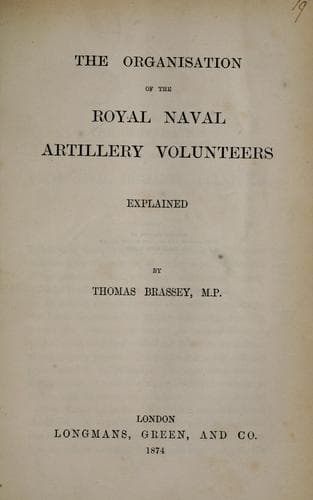
The Organisation of the Royal Naval Artillery Volunteers ExplainedBrassey, Thomas Brassey, Earl
History
The Organisation of the Royal Naval Artillery Volunteers Explained
Brassey, Thomas Brassey, Earl
Great Britain. Royal Naval Artillery Volunteers
When at drill, as it has already been pointed out, the
officer-instructor will superintend the instruction of the Volunteers,
and he will be responsible that all exercises are properly carried out,
in accordance with the regulations from time to time laid down for the
instruction of the Royal Navy. It will thus be evident that the
paramount and undivided authority of the naval officers over the
Volunteers when afloat, and the superior responsibility of the officer
of instruction when the Volunteers are at drill, so largely overshadow
the authority of the officers of the Royal Naval Artillery Volunteers in
all matters, excepting those which relate to discipline and the civil
administration and organisation of the corps, that it could not
reasonably be expected that retired naval officers of rank should
volunteer to become battery officers in the Royal Naval Artillery
Volunteer Corps. Naval officers of less exalted rank do not often
retire, if they have a great zeal for the service. Some exceptions,
however, there must be to this general rule; and it is probable that a
certain number of retired officers from the junior ranks of the Navy
will, hereafter, kindly offer their services to command brigades or
batteries in the ports or districts, in which they may happen to reside.
The Volunteers will at all times feel a pride in availing themselves of
such opportunities of acting under officers, who have received a high
professional training in Her Majesty's naval service.
While the effect of the arrangements, which have been described,
necessarily limits the sphere of the officers of the Royal Naval
Artillery Volunteers, their services, in several important points, are
not the less essential. It is to them that the Admiralty must look for
the exercise of their personal influence, in inducing recruits to join
their respective brigades and batteries; and their moral influence will
be the principal security for the maintenance of good discipline in a
force composed exclusively of Volunteers. Although, under the
regulations, no fixed standard of efficiency is expressly required in an
officer of the Royal Naval Artillery Volunteer force, those among them,
who can command sufficient leisure for the purpose, will readily
appreciate how excellent an effect must be produced by the personal
example of an officer, who will take pains to make himself acquainted
with the drills and exercises, in which the men under his command are
instructed. He will have the opportunity of obtaining the same
certificate of proficiency, which is given to those officers of the
Naval Reserve, who become qualified to drill the seamen of the reserve
at the great guns, and in the small arm exercises.
Public-domain text, read in full here on John Shaqi.
Reviews
Reviews
No reviews yet
Be the first to share your thoughts on this work.
Join the Discussion
Join the discussion
Sign in to leave a comment or review.
Sign InorCreate an account